One Link, Many Niches: How to Use Liinks When You’re Rebranding, Pivoting, or Still Figuring It Out

You know that awkward phase when your bio says “fashion blogger,” your content is about productivity, and your offers are… a Notion template, a group program, and a random Etsy shop you started during a bout of insomnia?
Yeah. That.
Rebrands, pivots, and “I’m experimenting” seasons are where most creators feel the mess the most. Your interests evolve faster than your profiles. Your offers change faster than your website. And your poor bio link is over there trying to hold 14 identities at once.
That’s exactly where a flexible link hub like Liinks quietly becomes your best friend.
This guide is all about using one link to support many niches, experiments, and direction changes—without confusing your audience or rebuilding your entire online presence every quarter.
Why Rebrands Feel So Messy (And Why Your Bio Link Is the Fix)
Rebrands and pivots are not just a “new color palette and a fresh headshot” situation. They usually come with:
- New offers or services
- New content pillars
- New audience segments
- Old links you can’t just delete (hello, evergreen freebies and old podcast episodes)
The chaos usually shows up in three places:
-
Mixed messages across platforms
TikTok says one thing, Instagram says another, your old YouTube description is lying outright. -
Scattered links and outdated pages
People click through to freebies you don’t support anymore, offers that are closed, or copy that doesn’t sound like you. -
Analysis paralysis for your audience
They tap your bio link and see a buffet of random buttons. No clear next step. No through-line.
Here’s the good news: you don’t have to have your niche perfectly nailed to look intentional. You just need one central hub that tells a clear, current story—no matter what you’re experimenting with this month.
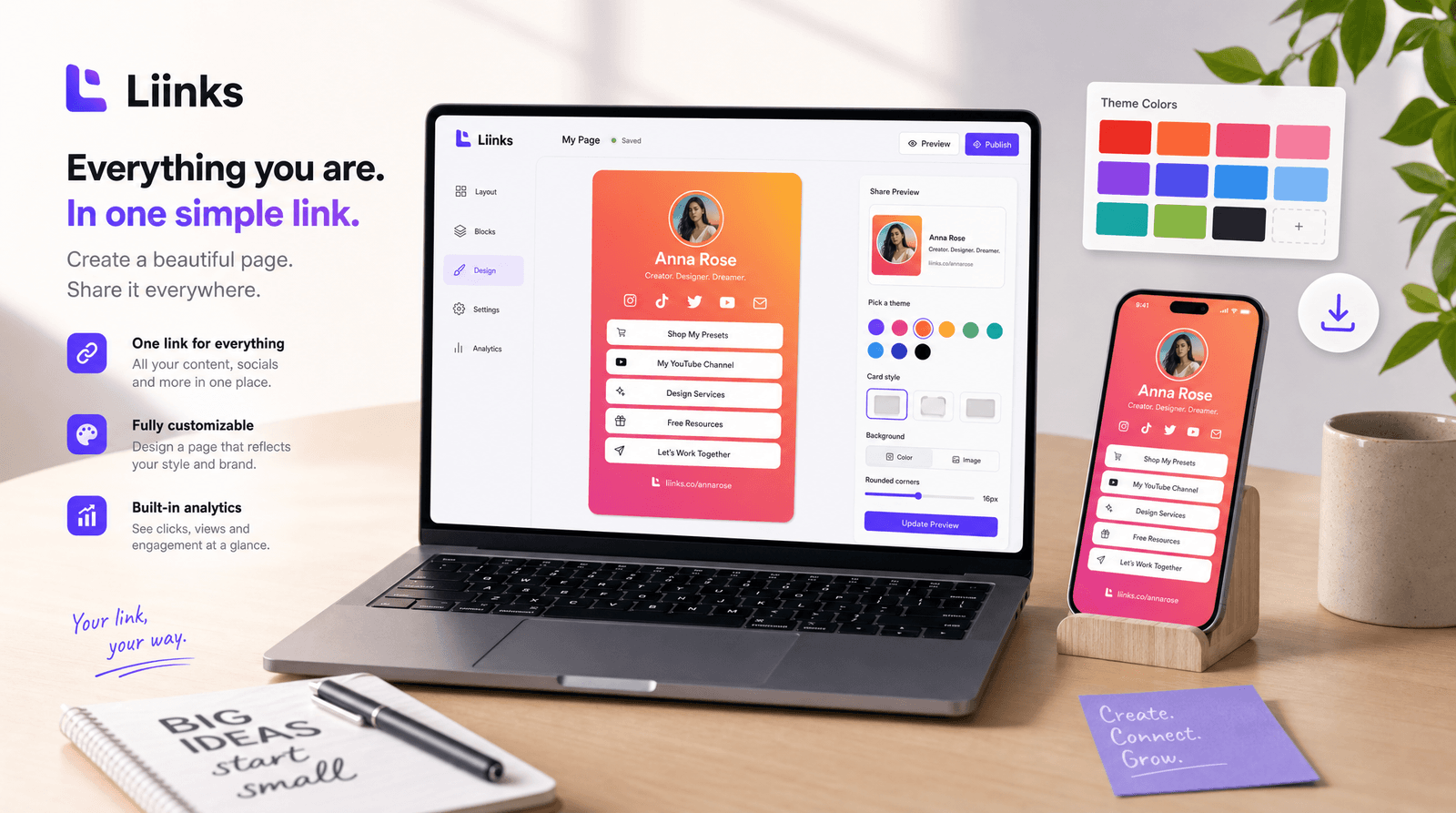
That’s what Liinks gives you: a flexible, good-looking mini homepage you can tweak in minutes while the rest of your brand catches up.
Three Types of “I’m Changing Things” (Which One Are You?)
Before you start rearranging buttons, it helps to know what kind of transition you’re actually in. Most creators fall into one of these buckets:
1. The Soft Pivot
You’re not burning it all down—you’re just shifting the spotlight.
- Example: From “beauty content creator” → “beauty + wellness creator”
- Or: From “social media tips” → “social media + creator business strategy”
Your goal: Re-train your audience to see you in a slightly new way without alienating people who liked the old you.
2. The Big Rebrand
New niche, new offers, maybe even a new name. You’re ready to be known for something different.
- Example: From “DIY home decor” → “online business coach”
- Or: From “lifestyle vlogger” → “personal finance educator”
Your goal: Help people understand the new direction quickly, while still capturing any relevant traffic from your older content.
3. The Multi-Passionate Era
You’re not sure you want to pick one lane. You’re testing a few things at once.
- Example: You’re posting about freelancing, content strategy, and productivity… and also selling digital art.
- Example: You’re a creator and a service provider and launching a podcast.
Your goal: Make your variety feel intentional instead of chaotic—and route people to what’s most relevant to them.
No matter which one sounds like you, your link hub is where you can quietly organize the chaos, test ideas, and update direction without rewriting every caption you’ve ever posted.
The Core Strategy: One Link, Clear Story
Here’s the simplest way to think about your Liinks page during a rebrand:
Your page should answer, in 5 seconds or less: Who are you now, and what should I click next?
To pull that off when you’re pivoting or multi-niche, you’ll want to:
-
Lead with the “current you,” not your history
Your top section and first 1–3 links should reflect where you’re going, not where you’ve been. -
Group experiments instead of scattering them
Instead of 10 random buttons, think in clusters: offers, content, experiments, brand partners, etc. -
Give different types of visitors clear paths
New here? Start here. Want to hire me? Go here. Just browsing content? Over here.
If you want more help with routing different audiences, you’ll love Stop Sending Everyone to the Same Page: Smart Liinks Routes for New vs. Super-Fans.
Step 1: Decide Your “Right Now” Identity (Even If It’s Temporary)
You don’t need a 10-year brand vision. You just need a 90-day identity.
Ask yourself:
- For the next 90 days, what do I most want to be known for?
- What’s the main action I want people to take from my bio link?
- What am I definitely not promoting anymore (even if old content still exists)?
Then translate that into:
-
A short headline on your Liinks page
- Example: Helping creators turn chaotic content into clean, profitable systems.
- Example: Beauty + wellness creator helping you feel good on and off camera.
-
1–2 primary buttons that match your current focus
- Example: “Start Here: My Free Content Strategy Guide”
- Example: “Work With Me: 1:1 Coaching & Services”
Everything else? It’s supporting cast.
Step 2: Build a Layout That Can Survive a Pivot
If your niche changes every few months, your layout needs to be stable even when the content changes.
Here’s a simple structure that works whether you’re a beauty creator, business coach, or multi-hyphenate chaos goblin:
Top: Identity + Primary Action
Keep this section tight and focused:
- Short bio line (who you are now)
- One main CTA button (what you want most people to do)
- Optional: 1–2 secondary CTAs for your other priority offers
Examples of main CTAs:
- “Start Here: Free Training for New Creators”
- “Shop My Presets + Templates”
- “Book a Strategy Session”
Middle: Choose-Your-Own-Adventure Paths
This is where “many niches” stops being confusing and starts feeling curated.
Create sections or clearly labeled buttons for your main directions, like:
- For brands & collabs – link to a Liinks-based media kit or portfolio
- For creators & clients – link to services, courses, or coaching
- For binge-watchers – link to your best YouTube playlists, podcast, or top posts
- For free resources – link to lead magnets, free challenges, or mini guides
The key is labeling. Don’t just say “Podcast” or “Newsletter.” Try:
- “Binge the Podcast: Online Business Without the Bro Vibes”
- “Join 3,000+ Creators Getting Weekly Content Prompts”
Bottom: Legacy Links (Without the Clutter)
You probably have links you can’t delete yet:
- Old freebies still getting traffic
- Evergreen affiliate links
- Archived offers you might revive later
Instead of giving them prime real estate, tuck them under one smart button:
- “Archive & Extras”
- “Legacy Freebies & Past Projects”
This way, people who came from old content can still find what they’re looking for, but new people aren’t distracted.
If you want layout inspo specifically, check out Mini Homepages, Major Results: Liinks Layouts That Replace a Full Website (Without Looking Cheap).
Step 3: Use Design to Signal the New You
You don’t have to redesign your entire brand every time you pivot. But your Liinks page is a low-effort place to signal the shift.
A few small tweaks go a long way:
-
Color palette:
- Moving from “fun lifestyle” → “serious consulting”? Tone down neons, lean into more muted or minimal tones.
- Going from “corporate escapee” → “creative educator”? Add bolder accent colors.
-
Typography:
- Clean, sans-serif fonts feel more modern and strategic.
- Playful or script accents can signal creativity or lifestyle.
-
Button hierarchy:
- Make your primary CTA visually louder (color, size, or placement).
- Use more neutral styles for secondary links.
If you’re DIY-ing the whole thing, Broke but Branded: A No-Designer Guide to Making Your Liinks Page Look Shockingly High-End walks through simple design decisions that make you look put-together without a big budget.
Step 4: Route Different Audiences Without Building 19 Pages
Rebrands get messy when everyone lands on the same generic page.
Instead, think about who’s actually clicking your link:
- New followers who just discovered you
- Long-time fans who already trust you
- Brands or clients checking you out
- Old traffic coming from older niche content
You don’t need 47 funnels. You just need a few smart routes.
Option A: One Main Page, Smart Sections
Keep a single Liinks page, but:
- Use clear section headers like “New Here?”, “Work With Me”, “For Brands”, “Free Stuff”
- Put “New Here?” and your main CTA at the top
- Add more specific paths below (e.g., “For TikTok Creators,” “For Coaches,” etc.)
Option B: Multiple Pages for Different Roles
If you’re juggling very different hats, you can create separate Liinks pages and route people accordingly:
- Main bio link → your general “hub” page
- From that hub, link out to:
- “I’m a brand or PR rep” → media kit page
- “I’m a creator or client” → services/offers page
- “I just want your content” → content hub page
This lets you keep your public bio link simple while still giving each audience a tailored experience.
Step 5: Keep Old Stuff Working While You Change Directions
The content you made two years ago is still out there doing laps for you. People are:
- Clicking links in old YouTube descriptions
- Tapping URLs in long-forgotten Instagram captions
- Finding you via Pinterest pins from a niche you don’t even talk about anymore
Instead of letting that traffic hit dead ends, use your Liinks page as a universal adapter.
Practical moves:
-
Replace old URLs with your Liinks URL wherever you can
- Update YouTube description defaults
- Update “website” fields on platforms
- Swap old landing page links in your social bios
-
Create a gentle redirect experience
When people arrive looking for something outdated, you can:- Keep the original freebie or resource available under “Legacy Freebies”
- Add a short line: “Found me from my old [topic] content? Start here instead.”
-
Use microcopy to explain the shift
A single line can clear up confusion:- “I used to talk all about DIY decor—now I help creators grow sustainable businesses. Here’s where to start.”
If you want to take this beyond just social and use your link everywhere, read Beyond “Link in Bio”: Smart Ways to Use Your Liinks URL in Newsletters, Podcasts, and Offline Marketing.
Step 6: Test Your New Direction Without a Full Identity Crisis
Rebrands feel risky because they are—you’re shifting what you talk about, sell, and prioritize.
Instead of guessing, use your Liinks page as a low-stress testing ground.
Simple experiments you can run:
-
Headline A/B test (manually)
- Try one positioning for 2–4 weeks (e.g., “Content Strategist for Creators”).
- Then try another (e.g., “Creator Coach Helping You Monetize Without Burnout”).
- Watch which version gets more clicks on your main CTA.
-
Offer order test
- Swap the order of your top 3 buttons.
- See if signups or bookings shift when a different offer is in the #1 spot.
-
“Start Here” vs. “Work With Me” emphasis
- For a month, push a free “Start Here” resource as your main CTA.
- Next month, make “Work With Me” the primary CTA.
- Compare leads, DMs, or sales.
If you want a more structured approach, A/B Test Your Link in Bio (Without Losing Your Mind): Simple Experiments That Actually Move the Needle walks through experiment ideas and what to track.
Step 7: Make It Easy to Update on Your “I Don’t Know What I’m Doing” Days
Rebrands and pivots come with feelings. Some days you’re like, “I am a visionary.” Other days you’re Googling “how to pick a niche” at 1:37 AM.
Your link setup should be simple enough that you can update it even on the messy days.
A few rules to keep you sane:
-
Cap your main buttons at 3–5.
If you add a new one, remove or demote something else. -
Create a monthly “check-in” ritual.
Once a month, ask:- Does my headline still feel true?
- Are my top 2–3 CTAs still the main things I care about?
- Is anything here outdated or irrelevant?
-
Keep a “parking lot” doc.
Instead of cramming every link onto your Liinks page, keep a simple doc with:- Offers you’re not promoting right now
- Past launches
- Archived freebies
When you’re tempted to add more, ask: Does this belong on the main page, or just in the parking lot for now?
If your content itself feels like a junk drawer, From Chaos to Clicks: How to Turn Your Content Dump into a Curated Liinks Resource Hub can help you turn “I have so much random stuff” into a tidy, useful hub.
Quick Recap: Your Pivot-Friendly Liinks Game Plan
Let’s bring it all together.
When you’re rebranding, pivoting, or experimenting with multiple niches, your Liinks page should:
- Lead with who you are for the next 90 days, not who you were last year
- Highlight one primary CTA that matches your current focus
- Use clear sections so different audiences know exactly where to go
- Tuck old-but-useful links into an “Archive” or “Legacy” area
- Signal the new vibe with simple design tweaks (colors, fonts, button hierarchy)
- Act as your testing ground, not just a static menu
- Stay easy to update, even on “what am I doing with my life” days
Your niche can evolve. Your offers can change. Your content can go through phases. But your one tiny URL can stay the same—quietly routing everyone to the most current, relevant version of you.
Your Next Step (Yes, Right Now)
If your current bio link looks like a time capsule of every version of you since 2020, this is your sign.
Here’s what to do in the next 30–45 minutes:
- Decide your 90-day identity and main CTA.
- Open Liinks and:
- Update your headline to match who you are now
- Reorder your buttons so the top 1–3 reflect your current priorities
- Create simple sections for “New Here?”, “Work With Me”, “For Brands”, and “Free Stuff” (or whatever fits your world)
- Remove or demote anything that doesn’t support where you’re headed.
You don’t need a perfect niche to look clear and intentional.
You just need one well-structured, good-looking Liinks page that tells the story of who you are right now—and leaves plenty of room for who you’re becoming.
Go give your tiny URL the glow-up it deserves.