Algorithm-Proof SEO: How to Get Found on Google with Just Your Liinks Page and Social Profiles

You know that moment when someone says, “You have to learn SEO,” and your brain immediately pictures a 300-page PDF, a $997 course, and a whiteboard full of arrows and acronyms?
Let’s not do that.
This guide is for the creator / small biz owner / “I refuse to touch WordPress” human who wants to:
- Show up on Google
- Get clients, subscribers, or sales from search
- Do it without a full website
Yes, you can get found using just your Liinks page and your social profiles. And yes, you can do it in a way that doesn’t collapse the second Google sneezes out a new algorithm update.
Welcome to algorithm-proof SEO.
Why “Algorithm-Proof” Even Matters
Search algorithms change constantly. What doesn’t change?
- People typing questions into Google
- Google trying to show them useful, trustworthy answers
- Brands and creators who win by being the obvious, helpful choice
If your entire strategy is built on “hacking” whatever trick works this quarter, you’re one update away from disappearing.
If your strategy is built on:
- Clear positioning
- Consistent naming
- Helpful content
- Strong profiles
…you’re pretty hard to erase.
That’s what we’re doing here: building a tiny but mighty search presence around your Liinks hub and your socials, so Google can connect the dots and keep sending you the right people.
The Big Picture: How Google Sees You (Without a Website)
If you don’t have a full site, Google mostly understands you through:
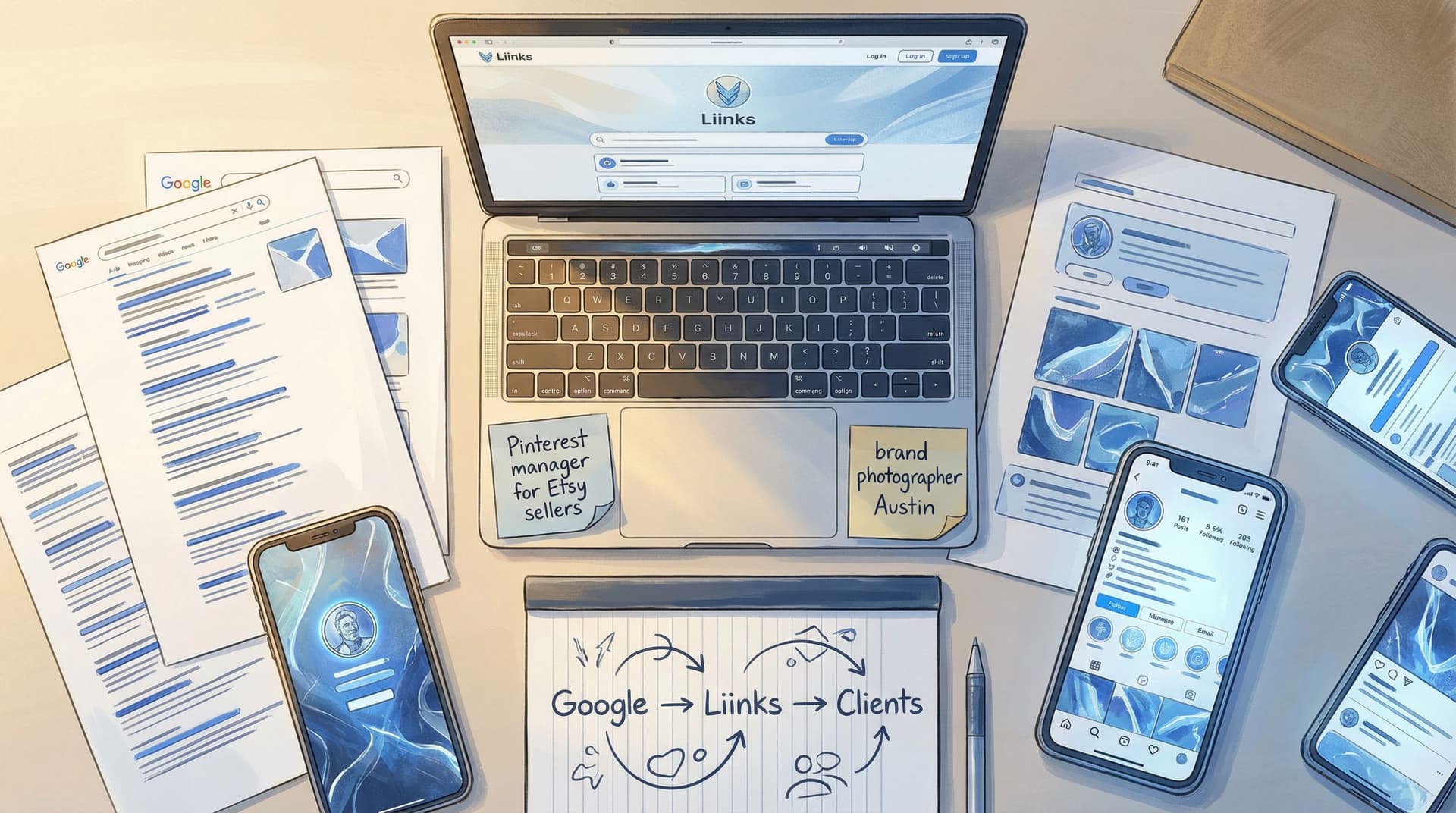
- Your link-in-bio hub – your Liinks page can act like a mini homepage
- Your social profiles – Instagram, TikTok, YouTube, LinkedIn, Pinterest, etc.
- Other mentions – podcast appearances, directory listings, guest content, etc.
Your job is to make all of those things:
- Consistent (same name, same handle, same "what I do")
- Searchable (using words people actually Google)
- Connected (everything links back to your Liinks hub)
If you want a deeper dive into how a link-in-bio hub stacks up against a full site, bookmark this for later: Link in Bio vs. Full Website: The SEO Tradeoffs No One’s Talking About.
Step 1: Decide What You Actually Want to Rank For
You can’t rank for “everything.” You barely have a full site. You have:
- A Liinks page
- A handful of social profiles
- Your content
So you need to be ruthlessly specific.
Pick 1–3 “I Want to Be Found For This” Phrases
Think in terms of:
- [Your role] + [your niche]
- “Pinterest manager for Etsy sellers”
- “Online fitness coach for new moms”
- [Service] + [audience or outcome]
- “Instagram Reels editor for coaches”
- “Brand photographer in Austin”
These become your core phrases. You’ll reuse them everywhere.
If you’re more visual than spreadsheet-y, think of this as your SEO version of an “offer menu” – a small set of clear, repeatable ways people can understand you. (If that idea clicks for you, you’ll love The Creator’s Offer Menu: Structuring Your Liinks Page So No Click Is a Dead End.)
Sanity-Check Your Phrases
Quick checks you can do in 10 minutes:
- Google it – Do real businesses and creators show up for that phrase? Good.
- Type it into Instagram / TikTok search – Do similar accounts pop up? Also good.
- Would your ideal client actually type this? If not, tweak.
You’re not trying to be clever. You’re trying to be obvious.
Step 2: Turn Your Liinks Page into a Tiny, Rankable Homepage
Your Liinks page is not just “the place where the buttons live.” For search, it’s your:
- Mini homepage
- Brand summary
- Central proof that you are, in fact, a real person who does real things
We’ve got a full deep-dive on this in SEO for People Who Don’t Want a Website: How to Make Your Liinks Page Actually Rank, but here’s the algorithm-proof version.
1. Nail the First 2–3 Lines of Text
Treat your headline + subhead like this:
- Line 1: What you are
“Pinterest Manager for Etsy Sellers” - Line 2: What you help them do
“I help Etsy shops double their traffic with done-for-you pin systems.”
Where your phrases go:
- Use your main phrase once in the headline
- Use a variation once in the subhead
2. Use Descriptive Section Titles
Instead of:
- “Work With Me”
Try:
- “Pinterest Management for Etsy Sellers”
- “Austin Brand Photography Sessions”
Google reads those section headings as context. You’re feeding it very specific context.
3. Give Your Main Links Keyword-Rich Labels
Avoid vague labels like:
- “Services”
- “Learn more”
Go for:
- “Pinterest Management Packages for Etsy Shops”
- “Book a Brand Photography Session in Austin”
- “1:1 Fitness Coaching for New Moms”
Think: if someone saw only the text on your Liinks page, would they know what you do and who you do it for?
4. Add a Short “About” Paragraph
Somewhere on your page, include 3–5 sentences that:
- Repeat your core phrases naturally
- Mention your location if it matters ("based in Austin, TX")
- Name-drop your main platforms ("I create weekly YouTube tutorials on…")
You’re not writing a novel. You’re giving Google and humans a clear summary to latch onto.
Step 3: Make Your Social Profiles Do SEO Heavy Lifting
If your Liinks page is your mini homepage, your social profiles are the billboards pointing at it.
Each major platform has spots where you can quietly bake in SEO without sounding like a robot.
- Name field:
Your Name | What you do- “Jess | Pinterest Manager for Etsy Sellers”
- Bio: 2–3 lines that:
- Say who you help and how
- Include 1–2 key phrases naturally
- Point to your Liinks page as the next step
Example:
I help Etsy shops turn pins into profit.
Pinterest management & strategy for product-based businesses.
↓ Grab the Pinterest starter kit
TikTok
- Name: Same format as Instagram if you can
- Bio: Short but clear:
- “Pinterest manager for Etsy shops | Tutorials & audits | Links ↓”
- Video descriptions:
- Use phrases like “Pinterest tips for Etsy sellers” in your captions
- Add 2–3 relevant keywords as hashtags instead of 25 random ones
YouTube
YouTube is secretly a search engine with a video addiction.
- Channel name: Include your niche if possible
- About section: 1–2 paragraphs using your main phrases
- Playlists: Name them clearly: “Pinterest Tips for Etsy Sellers,” “Beginner Reels for Coaches,” etc.
Every time you create a video, ask: What would someone type into Google to find this? Use that in your title and description.
LinkedIn (If You Use It)
- Headline: “Pinterest Manager for Etsy Sellers | Organic traffic without ads”
- About: Longer, story-based version of your positioning
- Featured section: Link to your Liinks page as your “hub”
Step 4: Optimize Individual Pieces of Content for Search
You don’t need 100 blog posts to show up in search.
You do need a few strong “searchable” pieces of content on platforms Google already loves:
- YouTube videos
- Pinterest pins and boards
- Public TikToks / Reels that answer clear questions
Create “Answer Content” Around Real Searches
Brainstorm 5–10 questions your ideal client actually Googles:
- “How to get more Etsy traffic from Pinterest”
- “What to wear for a brand photoshoot Austin”
- “Postpartum workout plan at home no equipment”
Then make:
- 1 YouTube video per question, or
- 1 TikTok/Reel + 1 in-depth caption, or
- A Pinterest pin that links to your Liinks page or a key resource
In your titles and descriptions, use the question or a close variation.
Example YouTube title:
How to Use Pinterest to Get More Etsy Sales (Step-by-Step Tutorial)
Description (first lines):
In this video, I’m breaking down how Etsy sellers can use Pinterest to drive more traffic and sales. If you’re an Etsy shop owner who wants a simple Pinterest strategy, this is for you.
Then link your Liinks page at the top of the description as your “hub” for:
- Services
- Free resources
- Email list
Google now sees a consistent pattern:
- "Pinterest for Etsy sellers" content
- Same creator name
- Same Liinks URL
- Same phrases repeated in helpful, non-spammy ways
That’s how you become the default answer over time.
Step 5: Build a Tiny, Intentional Backlink Web
You don’t need a PR team. You just need a handful of places on the internet that:
- Mention you by name
- Link to your Liinks page
- Confirm what you do
Some easy wins:
- Podcast guest spots
- When the episode goes live, ask them to link your Liinks page as your main link
- Directory listings
- Coaching directories, creative directories, local business listings – use your Liinks URL
- Collaborations
- Joint workshops, IG Lives, co-created freebies – have your partner link your Liinks hub in the description
- Your own profiles everywhere
- Any platform that asks for a “website” gets your Liinks URL
Think of this as sprinkling little “this person is real and does X” breadcrumbs across the internet.
Step 6: Make Every Click Count (a.k.a. Don’t Waste the Traffic You Get)
SEO is only half the story. Once someone finds you, your setup needs to do something with that attention.
This is where your Liinks page quietly becomes your funnel:
- Top section: Who you are + who you help (with your main phrases)
- Next: One primary action you want searchers to take
- Book a call
- Download a free guide
- Watch a “start here” video
- Below that: Secondary options for people who aren’t ready yet
- Follow on another platform
- Read/watch more content
If you want help turning that search traffic into actual bookings and sales, pair this guide with From Clicks to Clients: Mapping a Simple Service-Based Funnel Using Only Your Liinks Page.
Quick Conversion Checklist
On your Liinks page, make sure you have:
- A clear headline that matches what people just searched
- A primary button that says what happens next
- “Book a Pinterest Strategy Call”
- “Get the Etsy Pinterest Starter Kit”
- A short trust section
- 2–3 bullet points of results
- 1–2 screenshots or testimonials (see also: Screenshots Sell: How to Turn Social Proof into Strategic Liinks Sections That Quietly Close Clients)
- Clean, consistent branding so you don’t look like three different people on three different platforms
Remember: Google can bring people to your door. Your Liinks page is what makes them stay.
Step 7: Keep It Algorithm-Proof Over Time
This is the “maintenance mode” part. No spreadsheets required.
Things to Keep Stable
These should change rarely, if ever:
- Your core phrases (what you want to be known for)
- Your name / handle across platforms
- Your Liinks URL
Things to Update Quarterly-ish
Set a reminder every 3 months to:
- Refresh your Liinks headline + subhead if your niche sharpened
- Update your primary CTA based on what you’re selling or promoting
- Add your best recent content (YouTube, podcast, etc.) to your Liinks page
Things to Experiment With
Algorithms love fresh, helpful stuff. You can:
- Try new formats (carousels, short videos, tutorials)
- Answer new questions your audience keeps asking
- Run tiny experiments on your Liinks layout and CTAs
If you like the idea of low-pressure experiments that reveal what your audience actually wants, you’ll get a lot out of Beyond A/B Testing: Tiny Liinks Experiments That Reveal What Your Audience Really Wants.
The key is: your positioning stays consistent while your content and offers evolve.
That’s what makes this “algorithm-proof” instead of “algorithm-chasing.”
Quick Recap
You don’t need a 40-page website to show up on Google.
You need:
- Clear phrases you want to be found for
- “[Role] for [audience]” or “[Service] for [audience/outcome]”
- A Liinks page that acts like a mini homepage
- Headline, subhead, section titles, and link labels that use those phrases
- Social profiles that all tell the same story
- Name fields, bios, and content descriptions that match your positioning
- Searchable content on platforms Google already loves
- YouTube, Pinterest, TikTok/IG Reels that answer real questions
- A few strategic backlinks
- Podcasts, directories, collabs all pointing to your Liinks hub
- A Liinks layout that converts
- Clear primary CTA, proof, and simple next steps
Do those things consistently and you’ll build a search presence that survives algorithm mood swings.
Your Next Move (Yes, This Is Your Nudge)
Don’t try to do all of this at once. Pick one of these to do in the next 24 hours:
- Rewrite your Liinks headline + subhead using your “I want to be found for this” phrase
- Update your Instagram name field and bio to clearly say what you do and for whom
- Film one short video answering a question your ideal client would Google, and add your Liinks URL as the main link
Then, when you’re ready to turn that new search traffic into real results, log into Liinks and give your page a 10-minute tune-up.
Future you (and your future clients) will be very pleased with present you.