Link in Bio vs. Full Website: The SEO Tradeoffs No One’s Talking About

Creators get told two completely opposite things:
- “You need a full website for SEO if you ever want to be taken seriously.”
- “You don’t need a website at all—just a good link in bio and you’re golden.”
Cool. Helpful. Not confusing at all.
The truth? Both can be smart moves. Both can be a waste of time. And the difference often comes down to one thing almost no one is actually unpacking:
How search engines see your link in bio vs. your website—and what that means for your traffic, authority, and bookings.
Let’s pull back the curtain on the SEO side of this debate, so you can stop guessing and start building a setup that actually works for how you create, post, and sell.
Why This Question Actually Matters (More Than “Which Tool Is Cooler”)
If most of your audience discovers you through:
- TikTok, Instagram Reels, YouTube Shorts
- Podcast guest spots
- Word of mouth and DMs
…you might assume SEO doesn’t matter that much.
But here’s what is happening behind the scenes:
- People are Googling your name to see if you’re legit.
- Brand partners are searching for your handle + “rates” or “media kit.”
- Potential clients are searching your niche and stumbling on someone else who did set up their SEO properly.
So the real question isn’t “link in bio or website?” It’s:
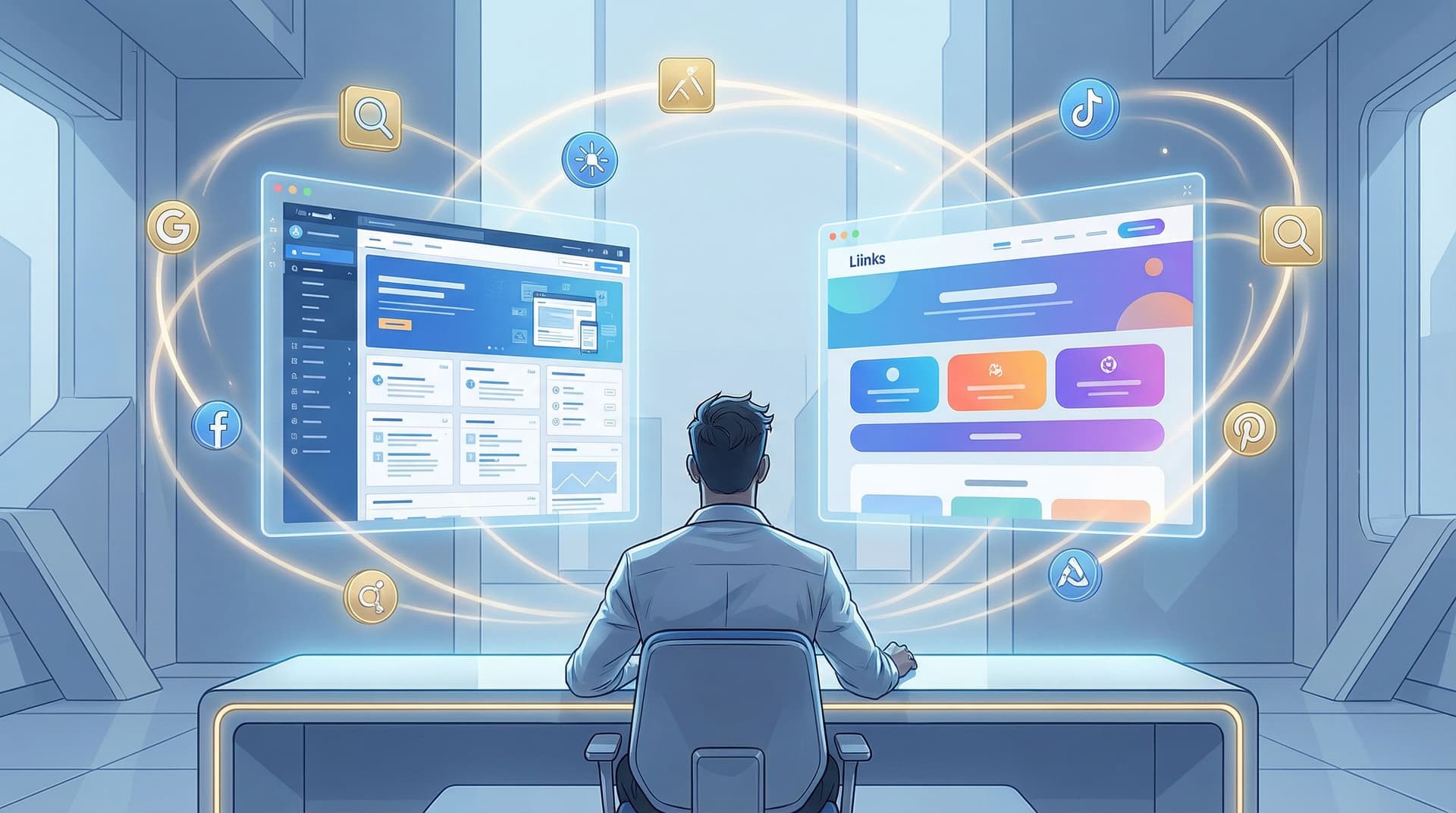
Where should your searchable presence live—and how can your link in bio and website work together instead of competing?
That’s where a flexible tool like Liinks comes in. Your Liinks page can be:
- A temporary homepage until your site is ready.
- A permanent hub that supports your site.
- Or, if you’re early-stage, a legit alternative to a full site.
But the SEO tradeoffs are different in each case. Let’s break them down.
How Search Engines Actually See Your Link in Bio
Most creators assume their link in bio is “just for social.” But search engines do crawl and index these pages—especially if:
- Your page is public (it is).
- Other sites or profiles link to it (they do).
- The tool you’re using is fast, mobile-friendly, and cleanly coded (this is where something like Liinks quietly helps you out).
What your link in bio is great at for SEO:
-
Name searches & branded searches
If someone Googles your handle or your name, your social profiles and your link hub often show up near the top. A polished Liinks page can act like a mini, SEO-adjacent homepage here. -
Click-through behavior
Search engines use engagement signals. If people click your name → land on your Liinks page → then click through to your key destinations (newsletter, offers, portfolio), that’s a good sign you’re relevant and trustworthy. -
Simplicity & speed
A lean, well-designed Liinks page usually loads way faster than a bloated DIY website. Speed is a ranking factor. Even if your Liinks page itself isn’t your SEO powerhouse, it’s not dragging you down.
Where link in bio pages are not built to shine:
- They’re not designed to rank for broad, non-branded keywords (like “online fitness coach for new moms” or “brand photographer in Austin”).
- They’re usually one page, which means limited content depth and internal linking (two things search engines love on full websites).
- They’re not where you’ll host long-form content like blog posts, case studies, or in-depth guides.
So if you’re trying to get discovered from scratch via Google? You’re going to want more than a bio link.
But if you’re trying to convert already-warm people who found you on social or heard you on a podcast? A well-structured Liinks page might be the MVP.
For more on when a Liinks page can actually replace a homepage (and when it shouldn’t), you might like: Your Homepage Is Overrated: When a Liinks Page Should (and Shouldn’t) Replace a Full Website.
What a Full Website Gives You That a Link in Bio Can’t (SEO Edition)
Let’s give the full website its flowers for a second. From an SEO perspective, a real site can do things a link in bio simply isn’t built for.
1. You Can Target Specific Keywords Intentionally
On a website, you can create:
- Service pages: “Podcast launch strategist for coaches”
- Location pages: “Brand photographer in Brooklyn”
- Blog posts: “How to plan a content shoot for your next launch”
Each page can be optimized around one main topic or keyword. Over time, this builds up a web of content that search engines understand and trust.
On a Liinks page, you don’t have that depth. You can link to those optimized pages—but you’re not doing the heavy lifting on the link hub itself.
2. You Can Build Authority With Content
Search engines love:
- Long-form guides
- FAQs
- Case studies
- Resource libraries
That’s not because they’re obsessed with word count; it’s because longer, well-organized content tends to answer user questions better.
You’re not going to publish a 2,000-word tutorial on your link in bio. You are going to link to it from your Liinks page so people can actually find it.
3. You Control the Technical SEO
With a website (especially if you’re using modern builders like Webflow, Squarespace, or even a well-setup WordPress install), you can:
- Edit title tags and meta descriptions
- Add schema markup (like FAQ, product, or review schema)
- Control URL structure
- Improve Core Web Vitals (speed, stability, responsiveness)
Your Liinks page doesn’t need any of that to do its job. But your site does.
So if your goal is search discovery, the full website wins. If your goal is conversion from social, your Liinks page is often doing more of the work than your homepage.
The Hidden SEO Upside of a Great Link in Bio
Here’s the part no one talks about: your link in bio can quietly support your SEO, even if it’s not the star of the show.
1. It Concentrates Your Authority
Instead of dropping 12 random links in your Instagram stories every week, you’re sending everyone to one hub: your Liinks page.
From there, you can:
- Route people to your most important SEO pages (your main service page, your best-performing blog, your portfolio).
- Keep those links consistent over time, so they accumulate more traffic and engagement instead of being replaced every two days.
Search engines notice when certain pages keep getting traffic, clicks, and time-on-page. Your link in bio can act like a traffic router that keeps feeding your best URLs.
2. It Reduces Bounce and Confusion
If someone Googles you, lands on your site, gets overwhelmed, and bounces? Not great.
If they land on a calm, clear Liinks page that says:
- “Start here: my best resources”
- “Work with me: services & pricing”
- “Watch: my most popular tutorials”
…and then from there click into your site? You’ve already filtered and guided them.
That means higher intent traffic hitting your key pages—and often better engagement metrics.
If you want to tighten up that Liinks page so it actually feels pro, bookmark The 10-Minute Link-in-Bio Audit: Quick Fixes That Make Your Page Look Instantly More ‘Pro’.
3. It Helps You Test What Deserves Its Own SEO Page
Think of your link in bio as your R&D lab:
- Add a button for a new offer or topic.
- Watch what people click for a month.
- If it gets traction? Then go build a full SEO-optimized page or blog post around it.
You don’t have to guess what content to create. Your Liinks click data is literally telling you what your audience wants more of.
When a Link in Bio Can Replace a Website (For Now)
There are seasons where a Liinks page + smart SEO choices are more than enough.
You’re probably in that zone if:
- You’re early-stage and most discovery is happening on TikTok, IG, or YouTube.
- Your offers are simple: 1–2 services, maybe a digital product or two.
- You don’t have the capacity to maintain a blog or multiple site pages.
In that case, here’s how to squeeze SEO-ish benefits out of your setup without going full “SEO specialist on LinkedIn” about it.
Step 1: Claim Your Name in Search
Even without a full site, you can:
- Use the same handle and username across platforms.
- Use your real name (or brand name) in your Liinks page title and description.
- Link your Liinks page from your main social profiles consistently.
This helps search engines connect your profiles and hub to your name.
Step 2: Make Your Liinks Page Readable (to Humans and Robots)
On your Liinks page:
- Add a short intro at the top that includes what you do:
“I’m Jess, a brand photographer in Austin helping creators and coaches look like the main character online.”
- Group links into clear sections:
- Work with me
- Start here
- Free resources
- Use descriptive link labels, not “Click here” or “New!”
This isn’t hardcore SEO, but it does make your page more understandable for both people and crawlers.
For help tightening up your structure, check out The Multi-Passionate Creator’s Map: Structuring One Liinks Page When You Do… Everything.
Step 3: Point to One Primary “Home” URL
If you don’t have a site yet, your Liinks page is your home base. Use it consistently:
- In podcast bios
- In guest post author boxes
- In your email signature
- On your business cards (if you’re fancy like that)
This builds link equity to one main URL instead of scattering it across random Calendly, Gumroad, and Notion links.
When You Really Do Need a Full Website (and How to Pair It With Liinks)
There comes a point where “just a bio link” starts to feel cramped.
You’re probably ready for a full site if:
- You’re getting inquiries from search already and want to scale that.
- You offer multiple services, packages, or programs that need explanation.
- You want to rank for niche or local keywords ("wedding photographer in Seattle," "Notion consultant for agencies").
- You have case studies, testimonials, and resources that deserve their own pages.
When that moment hits, don’t retire your Liinks page. Promote it. It becomes the bridge between your chaotic content universe and your nicely structured site.
Here’s how to make them play nicely:
1. Make Your Liinks Page the “Router,” Not the Destination
Your Liinks page should:
- Highlight your top 3–5 money-making pages (services, booking, shop, flagship lead magnet).
- Link to one best intro resource (your strongest blog post, YouTube video, or guide).
- De-emphasize everything else.
You’re not trying to mirror your whole site. You’re curating the entry points.
2. Use Your Site for Depth, Your Liinks for Momentum
On your site:
- Build out SEO-friendly pages for each service.
- Publish 1–2 high-quality, evergreen posts that answer the questions people are already asking you.
- Add clear CTAs on those posts (book a call, join the list, buy the template).
On your Liinks page:
- Feature those posts as “Start here” or “Most loved resources.”
- Update them seasonally instead of daily.
Your link in bio captures the attention your content earns—and then your site does the long-form convincing.
3. Let Data Tell You What to Optimize Next
Check two places regularly:
- Your Liinks click stats → Which links actually get tapped? Those are the pages that deserve better SEO (titles, meta descriptions, content depth).
- Your site analytics → Which pages people land on from your Liinks page, and what they do next.
If you notice, for example, that your “Book a brand shoot” page is the #1 clicked link from your Liinks hub, but the bounce rate is high? That’s your cue to:
- Improve the copy
- Add social proof (screenshots, testimonials—see also Screenshots Sell: How to Turn Social Proof into Strategic Liinks Sections That Quietly Close Clients)
- Clarify your packages
SEO is not just about traffic. It’s about what happens after the click.
Quick Decision Guide: Link in Bio, Website, or Both?
If you’re skimming (no judgment), here’s the TL;DR matrix:
You can lean on a Liinks-only setup if:
- You’re early-stage and most discovery is happening on social.
- You have 1–2 core offers and a simple customer journey.
- Your main SEO need is: “When people Google me, I don’t want them to find my MySpace.”
You should invest in a website plus Liinks if:
- You want to be found by people who don’t know you yet (via keywords, locations, or specific problems).
- You have layered offers, case studies, and resources that need space.
- You’re playing a long game with content and organic traffic.
Non-negotiable either way:
- One clean, on-brand Liinks page that acts as your control center.
- Clear, descriptive link labels (no mystery buttons).
- A simple path from “curious” → “click” → “book / buy / subscribe.”
Wrapping It Up: SEO Is the Long Game, Liinks Is the Shortcut
You don’t have to choose between:
- A perfectly SEO’d, 12-page website you never update, and
- A cute link in bio that looks good but lives in its own little universe.
You can:
- Use your Liinks page as the always-up-to-date hub where all your best stuff lives.
- Let your website handle the searchable depth—services, content, and authority-building pages.
- Use data from your Liinks clicks to decide what site pages to create or improve next.
Think of Liinks as the front door people actually walk through, and your website as the house you’ve been slowly renovating. Both matter. They just do different jobs.
Your Next Small Move (That Makes a Big Difference)
Instead of “redesign my entire online presence” (hello, overwhelm), try this:
- Open your current link in bio.
- Ask: “If a brand, client, or future fan landed here from Google or social, would they know what to do next?”
- If the answer is “uhhh,” spin up or refresh a Liinks page and:
- Add a one-sentence intro with what you do and for whom.
- Feature 3–5 links max: your main offer, your best intro resource, your email list, and one secondary offer.
- Rename every button so it reads like a tiny CTA, not a label.
Once that’s done, then decide whether your next project is:
- Building a simple, focused website to support SEO, or
- Doubling down on your Liinks hub while you keep growing via social.
Either way, you’ll have one clear, good-looking place to send all your hard-earned clicks—and that’s the foundation both SEO and sales are built on.