TikTok Shop, But Smarter: Using Liinks to Test Products Before You Go All-In on E‑Commerce

So you’ve been watching TikTok Shop creators rake in sales while casually unboxing things in their kitchen and thinking:
“Should I be selling something?”
Maybe you already are. Maybe you’re flirting with the idea. Either way, jumping straight into full e‑commerce mode—inventory, shipping, customer support, tax headaches—is a big commitment.
Here’s the good news: you don’t have to go all in to get real data.
You can use your link in bio as a low-risk test lab to figure out:
- What your audience actually wants to buy
- Which product angles and bundles convert
- Whether TikTok Shop (or any shop) is worth building around a specific offer
That’s where Liinks comes in. Instead of treating your bio link like a list of random buttons, you can turn it into a lightweight product-testing machine.
This post will walk you through how to do exactly that—so when you do go all‑in on e‑commerce, you’re not guessing.
Why Testing Products Before You Go All‑In Actually Matters
Let’s be honest: TikTok makes e‑commerce look a little too easy.
You see:
- A creator dropping a casual “link in bio”
- A TikTok Shop overlay with a shiny product card
- Comments like “I bought this so fast” and “TikTok made me buy it”
What you don’t see:
- The 4 product ideas that flopped before this one hit
- The abandoned carts
- The creators quietly eating the cost of unsold inventory
Before you start ordering 500 units of anything, you want answers to questions like:
- Does my audience want this at all?
- Do they want this version, or a different size/color/format?
- Are they more excited by Product A, Product B, or a bundle?
- Do they prefer physical products, digital products, or services?
You don’t need a full Shopify build, a warehouse, or a TikTok Shop integration to find that out.
You need:
- A few product hypotheses
- Simple ways to click-test interest
- A clean, on-brand hub where all that testing happens—your Liinks page
If you’ve read our post on experimenting with offers, you already know your bio link can be a revenue lab. If you haven’t, bookmark Creator Revenue Experiments: 7 Low-Lift Offers You Can Test This Month Using Only Your Liinks Page for later.
Step 1: Treat Your Liinks Page Like a Product Testing Lab
Most people treat their link in bio like a junk drawer. You’re not “most people.” You’re about to treat your Liinks page like a tiny, ruthless product lab.
Here’s the mindset shift:
- Your TikTok content = demand generator
- Your Liinks page = demand detector
Your job is to send people from TikTok (or Instagram Reels, YouTube Shorts, etc.) to a page that makes it stupidly easy to:
- Compare interest between multiple product ideas
- See which hooks and angles get the most clicks
- Learn what people are willing to pay attention to before you ask them to pay money
What this looks like in practice
On your Liinks page, you’ll:
- Feature 2–4 product concepts as separate, visually distinct sections
- Use clear, curiosity-driving titles and micro-copy
- Connect each section to a low-commitment action (not necessarily a full checkout yet)
For example:
- “Custom Notion Templates for Creators” → Waitlist or interest form
- “Content Calendar in a Day – 1:1 Strategy Session” → Booking link or application
- “Creator Merch: ‘Post It Anyway’ Hoodies” → Email capture or pre-order interest
You’re not promising the entire store yet. You’re asking: “Which of these do you care about enough to click?”
Step 2: Design a “TikTok Shop Preview” Layout on Liinks
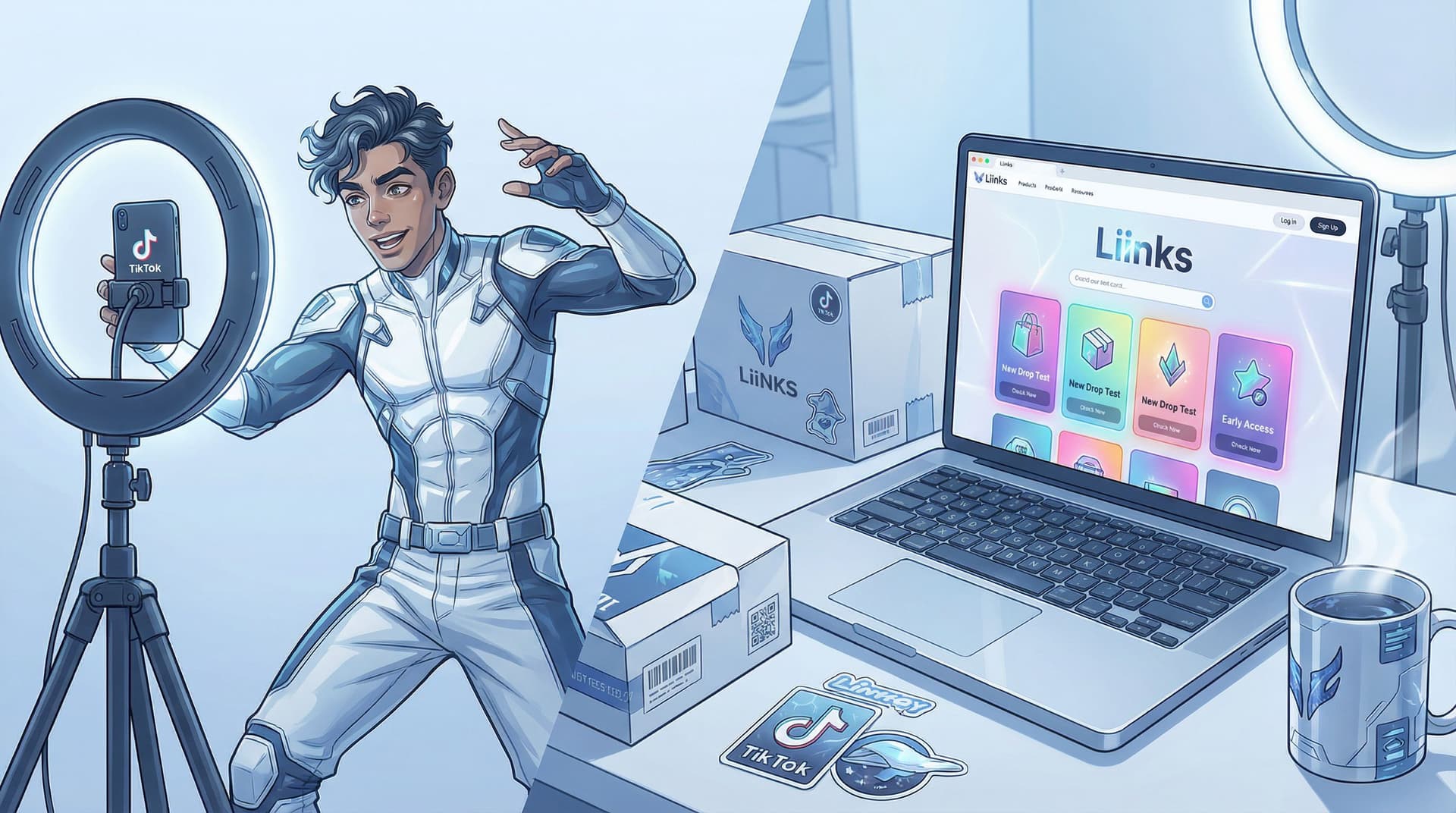
You don’t need the official TikTok Shop UI to give people a “shopping” experience. You can fake it (strategically) with a well-designed Liinks layout.
Build a mini product shelf above the fold
Use your first screen of content to show a tight, curated “shelf” of product experiments:
-
Hero section
- Short headline: “Shop My Most-Requested Creator Tools & Offers”
- One-line explainer: “Testing a few favorites—tap to vote with your clicks.”
-
Three to four product cards (max) Each “card” can be a Liink with:
- Product name
- One benefit-driven line
- A simple CTA like “I’d buy this” or “Get early access”
-
Secondary links below
- Your usual suspects: newsletter, YouTube, portfolio, etc.
- These live under your experiment shelf so your test data isn’t diluted.
Make it look like a shop, not a settings menu
Because Liinks is fully customizable, you can:
- Use product-style blocks with images or icons
- Color-code product categories (digital, physical, services)
- Add subtle dividers and headings like “New: Testing These Now”
If you want help making it feel polished and high-converting, check out The ‘One Scroll’ Strategy: Designing a Liinks Page That Sells Before Anyone Ever Clicks.
Step 3: Decide What You’re Actually Testing (Before You Obsess Over Clicks)
“Testing products” can mean a lot of things. Get specific about what you’re trying to learn.
Here are a few smart experiments you can run with nothing but your Liinks page and TikTok content.
1. Product vs. product
You want to know which type of product people want most.
Set up:
- Product A: Digital guide (e.g., “30 TikTok Hooks for Introverts”)
- Product B: Physical product (e.g., “Creator Desk Notepad”)
- Product C: Service (e.g., “TikTok Audit – 30 Minutes”)
Each gets its own Liink with a short description and a clear CTA.
What you’re measuring:
- Clicks on each product
- Click-through rate from the same batch of TikToks mentioning “my new shop experiments”
What you’ll learn:
- Whether your audience is more excited to buy information, things, or access to you
2. Angle vs. angle (same product)
Same core offer, different hooks.
Set up two Liinks for the same product:
- “Plan a Month of TikToks in 60 Minutes”
- “Never Stare at a Blank Caption Again”
Both lead to the same waitlist or sales page. The only difference is the framing.
What you’re measuring:
- Which link gets more clicks from the same audience over a set period (e.g., one week)
What you’ll learn:
- Which benefit your people care about most
If you’re into this kind of tiny experiment, you’ll love Beyond A/B Testing: Tiny Liinks Experiments That Reveal What Your Audience Really Wants.
3. Price sensitivity (without changing your actual price yet)
You don’t have to publicly yo-yo your prices to test price resistance.
Instead, you can:
- Use one Liink that emphasizes “under $20” or “under $50”
- Use another that emphasizes “premium, done-for-you”
Both can lead to:
- A short Typeform or Tally survey
- A “tell me more” email opt-in
- A simple “get on the list” form
You’re looking for which framing gets more people to raise their hand.
Step 4: Connect TikTok Content to Specific Liinks (On Purpose)
If you blast people to a generic page and hope for the best, your data will be… unhelpful.
You want content → Liink pairs that make it clear what people are reacting to.
Create “content clusters” around each product test
For each product concept, plan 3–5 TikToks:
- One “storytime” or origin story
- One “here’s the problem this solves” video
- One “behind the scenes / making of” clip
- One “soft pitch” with a direct “link in bio” mention
In each video:
- Use a consistent phrase for that product (e.g., “Creator Desk Kit”)
- Mention that it’s in your bio under a matching label
- Optionally, add on-screen text like “Tap my bio → ‘Creator Desk Kit’”
On your Liinks page:
- Make sure the product label matches the phrase you use in the video
- Keep that product near the top while you’re actively promoting it
This way, when you check your Liinks analytics, you know:
- Those clicks likely came from that batch of TikToks
- You’re not mixing data from random, unrelated content
Use temporary “spotlight” sections
One underrated Liinks move: create a temporary featured section for a product you’re actively testing.
For example:
This Week’s Experiment: Creator Desk Kit
Testing out a new bundle for creators who work from their couch. Tap below if you’d want this.
Underneath, include:
- A primary button: “I’d buy this – keep me posted”
- A secondary button: “Tell me what you’d change” (linking to a feedback form)
Now you’re not just testing interest—you’re collecting feedback that makes the final product better.
Step 5: Read Your Liinks Analytics Like a Product Manager
You don’t have to be a spreadsheet goblin to get value from analytics. You just need to know what questions to ask.
Inside your Liinks analytics, pay attention to:
-
Top-clicked products
- Which product Liinks are consistently in your top 3–5?
- Are they the same ones you thought people wanted, or are there surprises?
-
Click-through rate from profile to page
- If your profile → Liinks CTR is strong but product clicks are low, your page needs work.
- If profile → Liinks CTR is low, your TikTok content and bio might need clearer calls to action.
For more on decoding this, see CTR in Real Life: What Your Liinks Click-Through Rate Is Actually Telling You (and What to Fix First).
-
Drop-off patterns
- Are people only tapping the first product and ignoring the rest?
- Do they scroll past your “experiment shelf” and click your usual content instead?
That’s a signal you might need stronger copy, better visuals, or fewer options.
-
Time-bound tests
Don’t compare a product you promoted for one day to a product you promoted for three weeks.Run simple tests like:
- Week 1: Promote Product A + Product B equally
- Week 2: Promote Product C + Product D equally
- Week 3: Take the winners from Week 1 & 2 and pit them against each other
Your goal is not a perfect scientific study. Your goal is: “Which thing seems to light people up the most?”
Step 6: Move Winners into “Real” E‑Commerce (Without Losing Momentum)
Once a product concept clearly wins—more clicks, more signups, more DMs—you can start moving it into a more robust setup.
That might mean:
- Spinning up a Shopify or WooCommerce store
- Applying for TikTok Shop and listing that product
- Listing it on a marketplace like Etsy or Gumroad for digital goods
Your Liinks page becomes the bridge between your viral content and your actual store.
How to transition smoothly
-
Keep the product in the same spot on your Liinks page
- People who saw your earlier tests will remember roughly where to find it.
-
Update the micro-copy
- Change from “Vote with your click – early interest” to “Now live on TikTok Shop” or “Now shipping”.
-
Add social proof as it comes in
- Screenshots of early buyers, reviews, or UGC
- Link to a mini UGC gallery, and if you want to go deeper on that, read UGC, But Make It Clickable: Turning Fan Content into a High-Converting Liinks Showcase.
-
Use Liinks as your central hub even after launch
- Keep TikTok Shop, your main store, and any affiliate links organized
- Give people one easy place to navigate everything you sell
Remember: TikTok might be your discovery engine, but your Liinks page is your control center.
Step 7: Protect Your Energy with Low-Risk Product Formats
If the idea of holding inventory makes your eyelid twitch, start with low-risk formats you can still test via Liinks:
- Digital downloads (checklists, templates, presets)
- Workshops or live classes
- Micro-offers like low-ticket PDFs or mini audits
- Pre-orders where you only produce once you hit a certain interest threshold
You can:
- Use Liinks to collect pre-orders or waitlist signups
- Set a clear goal like, “If 50 people sign up, I’ll launch this as a full product”
- Pivot quickly if something doesn’t get traction—no boxes of unsold merch haunting your closet
If you want more ideas for tiny, testable offers, circle back to From Lurkers to Superfans: Using Micro-Offers on Your Liinks Page to Warm Up a Cold Audience.
Quick Recap: Your TikTok → Liinks → Shop Game Plan
Let’s pull this together into a simple, repeatable flow:
-
Brainstorm 2–4 product concepts
Mix formats: digital, physical, service, bundle. -
Turn your Liinks page into a test lab
Create a “shop preview” section with clear product cards and CTAs. -
Run focused TikTok content sprints
Make 3–5 videos per product, all pointing clearly to its matching Liink. -
Watch your Liinks analytics like a product manager
Look at top clicks, relative performance, and patterns over 1–3 weeks. -
Promote the winners to “real” products
Move best performers into TikTok Shop, Shopify, or another platform. -
Keep your Liinks page as the central hub
Use it to showcase your hero products, test new ideas, and organize everything you sell.
Your Next Step (Yes, This Is Your Nudge)
If you’re still in the “thinking about it” phase with e‑commerce, that’s actually perfect.
You don’t need to:
- Build a full store
- Order inventory
- Figure out shipping
You do need to:
- Set up a clean, on-brand Liinks page
- Add 2–4 product concepts as clickable tests
- Film a handful of TikToks that send people there on purpose
Let your audience tell you what they want—quietly, through their clicks—before you bet big on any one idea.
Your future TikTok Shop (and your future stress levels) will thank you.
Go set up your product test lab with Liinks, run your first tiny experiment this week, and see what happens when you stop guessing and start testing.