CTR in Real Life: What Your Liinks Click-Through Rate Is *Actually* Telling You (and What to Fix First)


You know that feeling when you finally check your link-in-bio analytics and see your click-through rate (CTR) and think:
“Okay… is this good? Bad? Should I panic? Should I celebrate? Should I rebrand and move to the woods?”
Let’s make this a lot less mysterious.
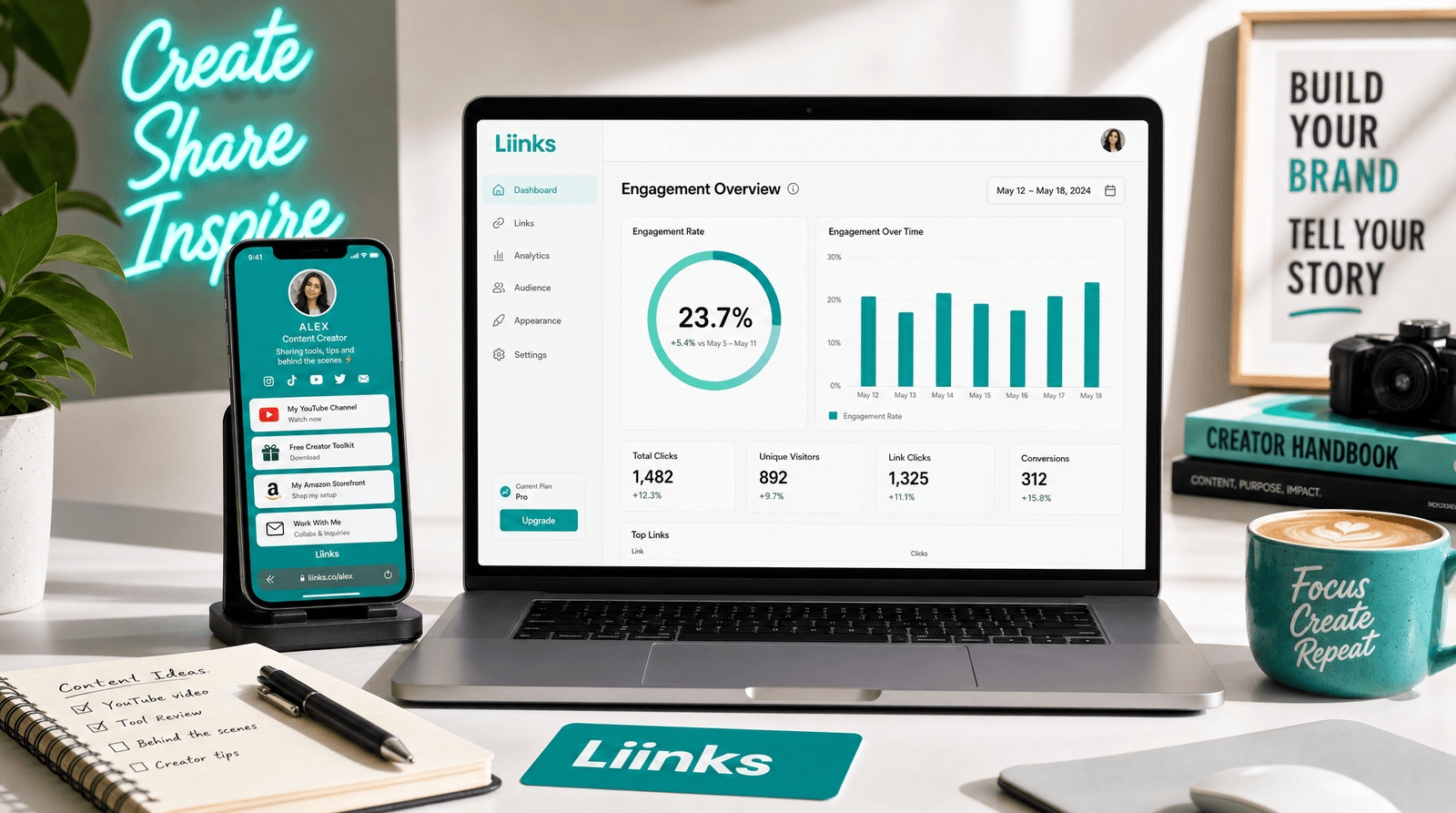
Your CTR isn’t just a random percentage. It’s a live, brutally honest review of how well your content, your offers, and your Liinks page are working together.
In this post, we’re going to decode what your CTR is really saying about your audience, and then walk through what to fix first so you’re not randomly rearranging buttons at 1 a.m. hoping for a miracle.
First: What CTR Actually Measures (Minus the Jargon)
CTR (click-through rate) is simply:
The percentage of people who view your page and actually click something.
On your Liinks page, you’ll usually see two flavors:
- Page CTR – Of everyone who lands on your Liinks page, how many click any link?
- Link CTR – Of everyone who saw a specific button or section, how many clicked that one?
Why this matters:
- It shows intent. People don’t tap your bio link by accident. If they land on your Liinks page and don’t click, something broke in the handoff.
- It reveals friction. Low CTR usually means confusion, clutter, or misaligned expectations.
- It helps you prioritize. Instead of guessing what to fix, your CTR tells you where your page is leaking attention.
If you’ve ever liked the idea of testing but hated the idea of spreadsheets, you’ll love how CTR works with tiny experiments. (If that’s your thing, you’ll want to read this next: Beyond A/B Testing: Tiny Liinks Experiments That Reveal What Your Audience Really Wants.)
Is My CTR “Good”? (And Why That’s the Wrong First Question)
You’ll see a lot of generic benchmarks floating around like “2–5% CTR is average” for social posts or “3–7% is solid” for certain types of links. That’s… fine. But for your Liinks page, the better question is:
Is my CTR getting better or worse over time, and on which links?
Because:
- A 10% page CTR might be bad if most of your traffic is warm, ready-to-buy followers.
- A 3% CTR might be excellent if most of your traffic is cold from viral content.
Think of CTR like your jeans: the size on the tag matters way less than whether they’re getting tighter or looser.
So instead of chasing a magic number, track:
- Baseline: What’s your average page CTR this month?
- Top links: Which 2–3 links get most of your clicks?
- Ghost links: Which links almost no one touches?
Once you know those three things, your CTR starts reading like a story instead of a scary math test.
What Your CTR Is Secretly Telling You
Let’s translate some common “CTR situations” into plain language.
1. High Page Views, Low Page CTR
What it looks like:
- Lots of traffic from Instagram/TikTok
- Page CTR is sad and flat
What it’s saying:
“People are curious enough to tap your bio… but confused or uninterested once they get there.”
Common causes:
- Your top fold doesn’t match what your content promised.
- Too many links competing for attention.
- Vague button copy like “New video” or “Check this out.”
First fix: clarity and focus above the fold (more on that in a minute).
2. Decent Page CTR, One Link Gets Almost Everything
What it looks like:
- Page CTR is okay
- One button hogs 70–90% of clicks
What it’s saying:
“Your audience cares a lot about this one thing, and is politely ignoring the rest.”
Common causes:
- You have one clear, compelling offer… and a bunch of “meh” extras.
- Your content only ever talks about that one thing.
- Other links are buried or sound boring.
First fix: lean into what’s working and either:
- Elevate related offers near that top link, or
- Remove or demote links that clearly don’t matter right now.
3. Low Views, High CTR
What it looks like:
- Not a ton of traffic
- But the people who land there click like crazy
What it’s saying:
“Your page is doing its job. You just need more people to see it.”
Common causes:
- You rarely mention your link in content.
- Your bio CTA doesn’t clearly invite people to tap.
- You’re relying on one platform instead of multiple traffic sources.
First fix: promotion, not layout. Your Liinks page is ready; your content needs to send more people there.
4. One Link Has Huge CTR, But Revenue/Bookings Are Meh
What it looks like:
- Lots of clicks on your main offer
- But few checkouts, signups, or bookings
What it’s saying:
“Your Liinks page is doing its job. The next step in the funnel is where people are dropping.”
Common causes:
- Confusing product page or booking form
- Pricing mismatch with what your content is attracting
- Slow or clunky site after the click
First fix: audit the destination of your highest-CTR links, not your Liinks layout.
For help turning those clicks into actual clients, check out From Clicks to Clients: Mapping a Simple Service-Based Funnel Using Only Your Liinks Page.
What to Fix First (Instead of Redesigning Everything)
Let’s triage your CTR like a pro instead of a panicked raccoon.
Step 1: Clean Up the “Above-the-Fold” Experience
Above the fold = what people see before they scroll.
On a Liinks page, this is prime real estate.
Your goal: When someone lands, they should instantly know:
- Who you are
- What you do
- The one main action they should take
Quick fixes:
- One primary CTA at the top.
- Examples:
- “Start here: binge my free crash course”
- “Book your 1:1 strategy session”
- “Shop my presets + templates”
- Examples:
- Supportive subheading. A 1-line explainer under your name/photo.
- “Helping creators turn followers into clients in under 90 days.”
- Remove clutter from the top.
- Move low-priority links (old freebies, random blogs, ancient offers) below the scroll or into grouped sections.
If you want a visual tune-up while you’re there, pair this with the tiny tweaks in The “Link in Bio” Glow-Up: Tiny Visual Tweaks That Make People Actually Want to Click.
Step 2: Rewrite Your Button Copy Like Micro-CTAs
Boring button copy is a silent CTR killer.
Compare these:
- “Newsletter” vs. “Get my weekly behind-the-scenes email”
- “Shop” vs. “Shop my exact client templates”
- “Coaching” vs. “Apply for 1:1 coaching (limited spots)”
Use this simple formula:
[Verb] + [Specific outcome] + (Optional urgency or qualifier)
Examples you can steal:
- “Download the Notion client dashboard I use daily”
- “Book your brand shoot consult in 2 taps”
- “Grab the free pricing guide (no email required)”
If you want to go deeper on this, you’ll love From ‘Check Out My Stuff’ to ‘Book Me Now’: Rewriting Boring Link-in-Bio Copy into Clickable Micro-CTAs.
Step 3: Ruthlessly Prioritize Your Links
If everything is important, nothing is.
Aim for:
- 1 primary action (top button)
- 2–4 secondary actions (still important, just not the star)
- Everything else grouped, demoted, or removed
Ask this about each link:
- Does this support how I actually make money or grow my list?
- Have I mentioned this in content recently?
- Would I be sad if no one clicked this for a month?
If the answer is “not really,” it’s either:
- A seasonal link
- A vanity link
- Or something that belongs in a “More resources” section at the bottom
On Liinks, you can group related links into sections, which is perfect for:
- “New here? Start with these”
- “For clients & students”
- “Free stuff to binge”
This keeps the page scannable and gives your best links room to shine.
Step 4: Match Your Links to Your Content (Expectation Alignment)
A sneaky reason CTR tanks: what your content promises and what your Liinks page delivers are not the same thing.
Examples of misalignment:
- Your Reel is about “how to get brand deals,” but your top link is a generic “Website.”
- Your TikTok points people to a free Notion template, but that template is buried as link #7.
- Your Story says “link in bio to book,” but the booking link is hidden in a general “Work with me” page.
Fix it by:
- Creating campaign-specific top links. When you’re pushing one offer for a week, let that be the clear #1 button.
- Mirroring language. If your post says “Grab the content planner,” your button should say something very close to that.
- Using simple emojis or tags. Things like “🔥 New: Content Planner” or “⭐ Most Popular: Strategy Call” to draw the eye.
Step 5: Use CTR to Run Tiny Experiments (Not Massive Overhauls)
You don’t need to redesign your whole Liinks page every time you get a new idea. You can:
- Change one thing
- Watch CTR for 3–7 days
- Keep or revert based on actual numbers
Simple experiments to try:
-
Swap top buttons.
- Week 1: “Book a 1:1 call” on top
- Week 2: “Start with the free workshop” on top
- See which drives more total clicks and better downstream results.
-
Test two versions of button copy.
- Version A: “Shop my presets”
- Version B: “Edit like me: shop my presets”
-
Try different structures.
- Version A: everything in one vertical list
- Version B: grouped into 2–3 sections with clear headings
Log your tweaks in a simple note or doc so you remember what changed and when. Over time, you’ll basically build your own personal playbook of “stuff my audience actually clicks.”
If you want a full, nerdy-but-fun walkthrough of these micro experiments, circle back to Beyond A/B Testing: Tiny Liinks Experiments That Reveal What Your Audience Really Wants.
When CTR Is Fine… But You Still Feel Stuck
Sometimes your numbers aren’t bad, they’re just… meh. That’s usually a sign your page is technically working, but strategically underperforming.
A few advanced upgrades to consider:
- Add micro-offers. Instead of sending everyone straight to a big, expensive offer, add a low-friction step first—like a $9 resource or a free mini training. (You can dig deeper into that idea in From Lurkers to Superfans: Using Micro-Offers on Your Liinks Page to Warm Up a Cold Audience.)
- Show proof near high-intent links. Place testimonials, screenshots, or mini case studies right above or below your main “Work with me” or “Buy now” buttons.
- Segment by intent. Create sections like “Just browsing,” “Ready to learn,” and “Ready to hire” so people can self-sort into the right next step.
Your CTR will often improve when people feel like your page “gets” them and isn’t trying to push everyone into the same action.
Quick CTR Debug Checklist
If your click-through rate is stressing you out, run through this list:
- Does my top section clearly say who I am + what to do next?
- Is there exactly one obvious primary CTA?
- Are my buttons written as specific, benefit-driven micro-CTAs?
- Have I ruthlessly pruned or demoted low-priority links?
- Does my page layout match what I’ve been talking about in content this week?
- Am I experimenting with one change at a time instead of chaos-editing everything?
If you can honestly say “yes” to most of these, your CTR will almost always trend up over the next few weeks.
Bringing It All Together
Your Liinks CTR is not a grade on your worth as a creator or business owner.
It’s a dashboard.
It’s telling you:
- Where people get excited
- Where they get confused
- Where your offers and your content are perfectly aligned—or totally missing each other
When you:
- Clean up your above-the-fold experience
- Write sharper, more specific micro-CTAs
- Prioritize a small number of high-impact links
- Align your page with what you’re actually talking about
- Use CTR to run tiny experiments instead of giant redesigns
…your link in bio quietly transforms from “a list of stuff” into a tiny, good-looking conversion engine.
And that’s exactly what tools like Liinks are built for: making it stupidly easy to tweak, test, and polish your page until those percentages start climbing.
Your Next Move (Yes, Right Now)
Don’t go build a new funnel. Don’t go buy a new tool. Do this instead:
- Open your Liinks analytics.
- Note your current page CTR and your top 3 links by clicks.
- Make one change:
- Rewrite your top button as a stronger micro-CTA, or
- Move your most important offer to the very top, or
- Remove 2–3 low-priority links from above the fold.
- Leave it for 5–7 days.
- Check your CTR again.
That’s it. You just ran a real experiment.
If you don’t have a Liinks page yet—or yours is three aesthetics ago—this is your sign to set it up or give it a glow-up so those hard-earned clicks actually go somewhere useful.
Your audience is already tapping your bio. Let’s make sure your CTR proves it was worth the trip.