Beyond Beacons and Linktrees: What Actually Makes a Link-in-Bio Tool ‘Good’ in 2025?


Everyone has a link in bio now.
Creators, coaches, Etsy shop owners, your cousin with three posts and a dream—everyone’s running some combo of links behind that tiny URL. Tools like Beacons and Linktree made it easy to get started.
But “easy to start” is not the same as “good for your business.”
So what does make a link‑in‑bio tool actually good in 2025—good enough to support launches, sponsors, clients, and consistent revenue, not just vibes?
Let’s break down the difference between “I have a link in bio” and “my link in bio quietly runs half my business.”
Why This Matters More Than Your Follower Count
Your content gets attention. Your bio link decides what that attention turns into.
A strong link‑in‑bio setup can:
- Turn casual scrollers into subscribers and buyers instead of one‑time lurkers.
- Give you a single, stable home base even while platforms and algorithms play musical chairs.
- Make you look instantly more legit to brands, clients, and collaborators.
- Save you time by replacing complicated funnels and half‑finished websites with one focused hub.
If you’ve ever yelled “link in bio!” into the void and gotten… crickets, it’s usually not your content that’s broken. It’s the page behind that link.
If that’s you, you’ll probably also love our deep dive on turning random links into an actual revenue plan: “Link in Bio” Is Not a Strategy: How to Turn Random Links into a Real Revenue Plan with Liinks.
Rule #1: Good Tools Don’t Fight Your Brand
A good link‑in‑bio tool should feel like an extension of your brand—not a generic template you’re renting.
Here’s what that looks like in 2025:
1. Real visual control, not just “pick a pastel”
You should be able to:
- Use your exact brand colors (hex codes, not “close enough”).
- Choose fonts that match your content style—playful, minimal, bold, whatever.
- Add imagery, icons, or section headers so the page looks designed, not stacked.
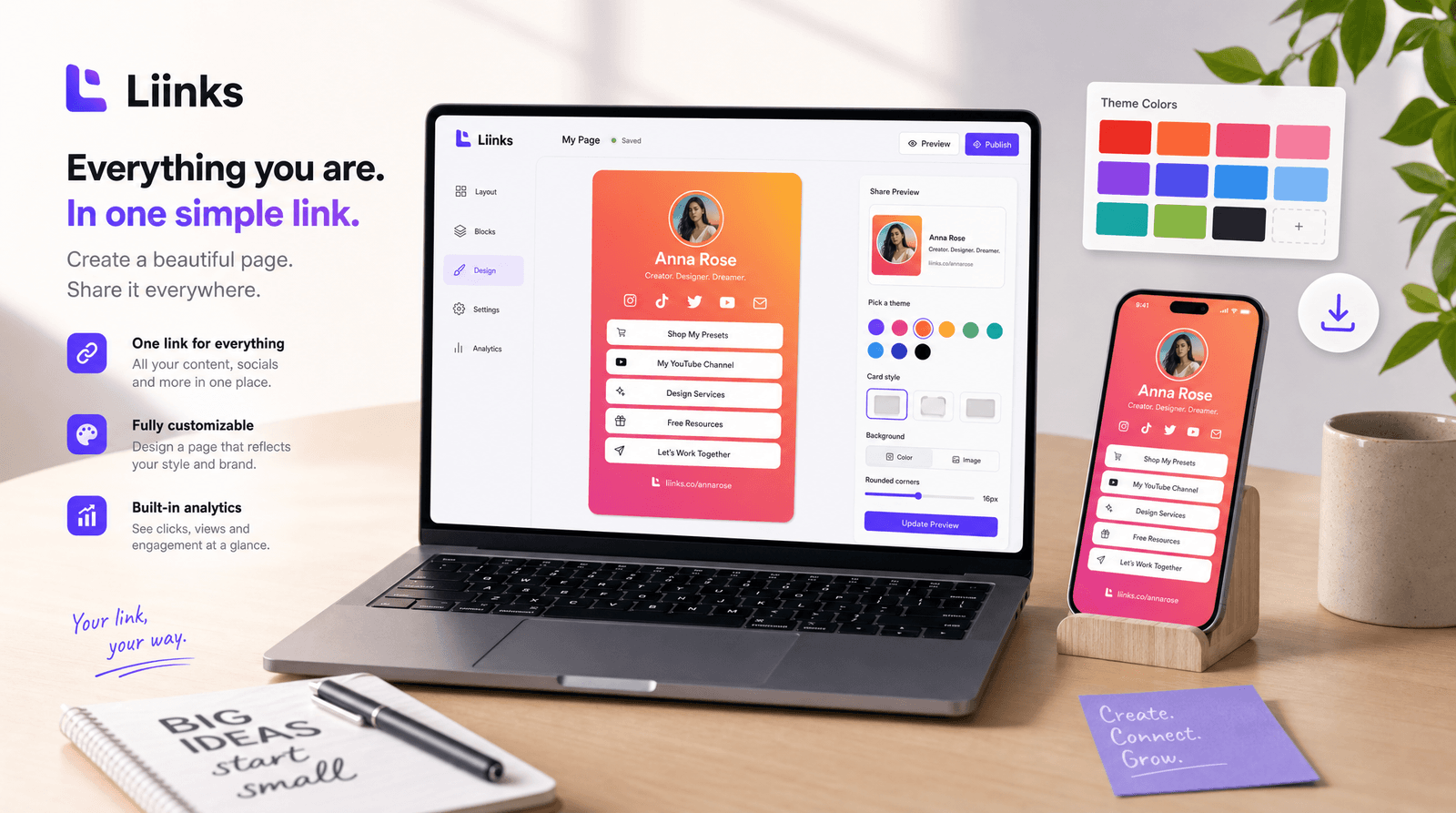
Liinks is built around this idea: creators get a flexible, fully customizable page that actually looks like them, not like every other “link in bio” on the internet.
2. Consistency across platforms
Someone should be able to go from your TikTok to your YouTube to your bio link and immediately think, “Yep, same person.”
That means:
- Matching profile photo and color palette
- Similar tone of voice in your mini‑headlines and button copy
- A layout that reinforces what you’re known for (educator, entertainer, shop owner, service provider, etc.)
If you want a more tactical walkthrough of how to do this, bookmark Brand-Safe but Still You: Designing an On-Brand Liinks Page That Matches Your Entire Online Presence.
3. No platform’s logo louder than your own
If the tool’s branding is shouting louder than yours, that’s a red flag.
Your name, your offer, your visuals should be the main event. The tool should be the quiet infrastructure, not the star of the show.
Rule #2: Good Tools Are Built for Funnels, Not Just Lists
If your link‑in‑bio tool treats your page like a static list of buttons, it’s already behind.
In 2025, a good tool helps you build a mini funnel—a guided path from “I’m curious” to “I know exactly where to click next.”
What that looks like:
- Prioritized hierarchy – Your most important action (join, buy, book, apply) should be visually dominant. Secondary links can sit below or in a separate section.
- Sections or blocks – Group links by intent: “Start here,” “Shop,” “Learn,” “Work with me,” etc.
- Micro‑copy that leads people – Tiny bits of text above or below buttons that answer “why this?”
Tools like Liinks make this easy with flexible layouts and content blocks, so your page feels more like a mini homepage than a receipt.
For a deeper dive into turning that one page into a small but mighty funnel, check out One Liinks Page, Many Personalities: How to Create Custom Experiences for Different Audiences.
A Simple Funnel‑First Layout You Can Copy
Use this layout as a quick test for whether your current tool can keep up:
- Hero section
- 1–2 lines: who you are + what you help with
- One primary button (your #1 goal right now)
- “Start here” for new people
- A short intro link or “New? Watch this first” style button
- Featured offer or content
- Your main product/service or current promo
- Deep‑dive options
- Links to your best resources, playlists, or blog posts
- Social proof or credibility (if your tool allows)
- Logos, testimonials, stats, or “trusted by…” style text
If your current tool can’t support at least some version of this flow, it’s holding you back.
Rule #3: Good Tools Are Ridiculously Quick to Update
You should not need:
- A laptop
- A 30‑minute block on your calendar
- The patience of a saint
…just to swap a link.
In 2025, a good link‑in‑bio tool is:
- Mobile‑first – You can update links and layouts from your phone between meetings or while waiting for coffee.
- Instant to publish – No lag, no “it’ll update in a few minutes.” Your page should reflect changes as soon as you hit save.
- Reusable – You can clone layouts, reuse sections, or quickly toggle seasonal promos on/off without rebuilding from scratch.
This matters because your content is dynamic. You’re launching, testing, and refining constantly. Your bio link should keep up without becoming another full‑time job.
If you want a setup that doesn’t require constant babysitting, you’ll like Evergreen, Not Exhausting: How to Build a Liinks Page You Barely Touch but Always Converts.
Rule #4: Good Tools Help You Make Money (Quietly)
Let’s be honest: you’re not doing all this for fun stickers and validation. A good link‑in‑bio tool should directly support your revenue.
Look for features that:
-
Highlight offers, not just links
Can you feature products, services, or bundles with images, short descriptions, and clear CTAs? -
Support lightweight storefronts
If you sell digital products, presets, templates, or merch, your tool should let you:- Group products
- Use visuals
- Guide people to a simple checkout path
-
Play nicely with your stack
Integrations with email platforms, checkout tools, and calendars mean fewer clicks and more conversions.
Liinks is built with this in mind—you can turn your page into a lightweight storefront or service hub without spinning up a full website. If that’s your next move, read Make Every Post Shoppable: A Step-by-Step Guide to Building a Lightweight Storefront with Liinks.
Quick Revenue‑Boost Checklist
If your current tool can’t do at least three of these, it might be time to move on:
- Pin your main offer in a visually prominent way
- Use different layouts for “shop,” “learn,” and “work with me” sections
- Add urgency or time‑sensitive promos near the top
- Track which offers get the most clicks
- Create alternate pages for special campaigns or sponsors
Rule #5: Good Tools Give You Just Enough Data (Without the Spreadsheet Hangover)
More data is not always better. Better data is better.
A good link‑in‑bio tool in 2025 should show you, at a glance:
- Total page views – Are people actually tapping your bio link?
- Click‑through rates on each button – Which links pull their weight, and which are just taking up space?
- Top traffic sources – Are clicks coming from Instagram, TikTok, YouTube, email, or somewhere else?
You shouldn’t have to decode 15 different graphs to answer two questions:
- Is my page doing its job?
- What should I change next?
If you want a simple walkthrough of what to track (and what to ignore), check out Analytics Without the Headache: The Only Liinks Metrics Creators Actually Need to Track.
Simple Experiments Your Tool Should Support
A good platform makes it easy to run tiny, low‑stress tests like:
- Testing two different headlines for your main offer
- Swapping the order of your top three links
- Comparing “Get the guide” vs “Download the free guide” on your CTA button
If changing those things feels like defusing a bomb, your current setup is doing the most… in the worst way.
Rule #6: Good Tools Are Platform‑Agnostic (Because Algorithms Are Chaotic)
If your bio link strategy only works on one platform, you’re building on quicksand.
A good tool should:
- Work equally well when shared on Instagram, TikTok, YouTube, X, Pinterest, email signatures, podcasts, and QR codes.
- Load quickly and look great on any device.
- Give you one main URL you feel confident dropping everywhere.
That way, when a platform throttles reach or randomly changes link rules, you’re annoyed—but not stranded.
If you’re ready to treat your link as a stable home base instead of a single‑platform accessory, you’ll like Algorithms Change. Your Links Don’t: Future-Proofing Your Brand with a Platform-Agnostic Liinks Strategy and Beyond Instagram: Unexpected Places to Drop Your Liinks URL (That Actually Drive Clicks).
Rule #7: Good Tools Feel Like a Mini Website (Without the Tech Spiral)
You don’t always need a full custom site. You do need a place that:
- Explains who you are
- Shows what you offer
- Makes it obvious where to go next
A strong link‑in‑bio tool should let you:
- Add sections, headings, and visuals so the page feels like a mini homepage
- Tell a short story with your layout—from intro → value → offer → next steps
- Swap between “portfolio,” “storefront,” or “creator hub” vibes depending on your business
This is where Liinks really shines: it’s flexible enough to replace a simple website for a lot of creators, without forcing you into a tech spiral. If you’re curious how far you can push that, read Mini Homepages, Major Results: Liinks Layouts That Replace a Full Website (Without Looking Cheap).
How to Audit Your Current Link-in-Bio in 10 Minutes
Grab your phone. Open your bio link as if you’re a stranger who just discovered you.
Run through this checklist:
-
Can I tell what you do in under 5 seconds?
If not, you need a clearer headline and hero section. -
Is there one obvious “main thing” to click?
If everything looks equal, nothing stands out. Promote one primary action. -
Are there more than 7–8 visible links?
If yes, you’re probably overwhelming people. Trim or group. -
Does the page feel like you?
Colors, fonts, tone—do they match your content and personality? -
Would a potential client or sponsor be impressed, or confused?
Be brutally honest here. -
Do you know which links are actually working?
If your tool doesn’t show this clearly, you’re guessing.
If you’re failing more than two of these, the problem isn’t you. It’s your setup—and likely the tool you’re using.
So… What Actually Makes a Link-in-Bio Tool “Good” in 2025?
Let’s put it all in one place.
A good link‑in‑bio tool in 2025 should:
- Look like your brand, not a generic template
- Support funnels, not just lists of random URLs
- Be fast and painless to update, especially on mobile
- Help you make money, not just collect clicks
- Offer clear, simple analytics that guide decisions
- Be platform‑agnostic so you’re not tied to one app’s mood swings
- Feel like a mini website without requiring a web‑dev degree
That’s the philosophy behind Liinks: a flexible link‑in‑bio tool built for creators who want their page to actually look good and quietly carry serious business weight.
Your Next Step (Yes, Just One)
Don’t go rebuild everything tonight. Pick one concrete move:
- If your page looks off‑brand → Tighten your design (colors, fonts, hero copy).
- If your page is a link graveyard → Pick one primary goal and reorder everything around it.
- If you’re stuck with a tool that fights you → Test‑drive a more flexible option like Liinks and rebuild a simple, focused version of your page.
Your bio link doesn’t need to be perfect. It just needs to:
- Make sense.
- Look like you.
- Point people somewhere that actually matters.
Start there. Your future self (and your future revenue screenshots) will be very into it.