Creator Funnels for People Who Hate Funnels: A No-Jargon Guide Using Liinks

You know that feeling when someone says “You just need a funnel” and your brain immediately leaves the chat?
Same.
If the word funnel makes you picture complicated diagrams, 47-email sequences, and a marketing bro with a whiteboard, this guide is for you.
We’re going to talk about creator funnels in a way that doesn’t require:
- Fancy software
- A marketing degree
- You saying “synergy” with a straight face
Instead, we’ll use one thing you already have (or should have): your link in bio—powered by Liinks, the flexible link-in-bio tool built for creators who want their page to actually look good.
Wait, What Is a Funnel (Without the Jargon)?
Let’s strip it down.
A funnel is just:
A simple path that moves people from “Who is this?” → “I like this” → “Take my money / email / time.”
That’s it.
No one wakes up saying, “I can’t wait to enter someone’s marketing funnel today.” They:
- See your content
- Get curious
- Tap your bio link
- Decide whether to:
- Follow deeper
- Sign up
- Buy
- Or bounce
Your “funnel” is just how you intentionally guide those curious people to the right next step.
And because almost all of that path runs through your bio link, your Liinks page is the easiest place to build a funnel without building a funnel.
If you want a deeper breakdown of why that tiny URL matters so much, you might like “Link in Bio” Is Not a Strategy: How to Turn Random Links into a Real Revenue Plan with Liinks.
Why This Matters More Than Your Follower Count
You can’t deposit followers in your bank account.
What actually pays you is:
- Email subscribers who open your stuff
- Clients who book your services
- Customers who buy your products
- Brands who see you as a safe bet for their budget
A simple creator funnel helps you:
- Turn random profile taps into real outcomes (signups, sales, bookings)
- Stop sending everyone to the same generic page that tries to do everything and ends up doing nothing
- Make decisions once (what’s the main path you want people to take?) instead of rewriting your entire strategy every launch
Think of your funnel as a friendly tour guide, not a trap:
- “Hey, you’re new? Start here.”
- “You’re ready to buy? Go here.”
- “You’re a brand? This way, please.”
Your Liinks page is where that tour quietly starts.
If you want inspiration on how that page can look and feel, check out Mini Homepages, Major Results: Liinks Layouts That Replace a Full Website (Without Looking Cheap).
The 3-Part Creator Funnel (That Doesn’t Suck Your Soul)
Forget the 8-stage, color-coded diagrams. For most creators, you only need three parts:
- Attention – your content
- Bridge – your bio link
- Destination – the thing you actually want them to do
You’re already working hard on #1 and #3. #2 is where things get leaky.
Let’s fix that using Liinks as your bridge.
Step 1: Pick One Main Outcome (Yes, Just One)
If your Liinks page tries to:
- Grow your email list
- Sell your course
- Book 1:1 calls
- Get podcast downloads
- Push your merch
…all equally, nothing wins.
Your first job: choose your primary goal for the next 60–90 days.
Examples:
- “I want more email subscribers so I’m not at the mercy of algorithms.”
- “I want more client inquiries for my done-for-you service.”
- “I want more sales of my signature product.”
Once you pick that, everything else becomes easier:
- Your top button
- Your page layout
- Your CTAs in content
All point to that one main outcome.
If you’re panicking because you have multiple offers, breathe. You’re not deleting anything—you’re just giving one thing the spotlight for a bit.
Step 2: Map the “Laziest Possible Path”
People are tired. They’re scrolling with one thumb and half a brain cell.
Your job is to design the laziest possible path from “I tapped the link” to “I did the thing you wanted me to do.”
Ask yourself:
- Where are they coming from?
- A TikTok tutorial?
- An Instagram Story rant?
- A YouTube video?
- What have they already seen or heard?
- Do they know who you are?
- Do they know what the offer is?
- What is the very next micro-step?
- Enter email
- Tap “Book a call”
- Add to cart
Design your Liinks page so that the main path is stupidly obvious:
- Big, clear headline at the top (“Start Here: Free Notion Template for Creators”)
- One primary button in a contrasting color
- Supporting links below, not competing with it
For layout inspo that stops people mid-scroll, see Scroll, Pause, Click: Designing Liinks Pages That Stop the Doomscroll and Start Conversations.
Step 3: Turn Your Liinks Page into a Mini Funnel (Without Extra Software)
Here’s how to build a no-drama funnel directly on Liinks.
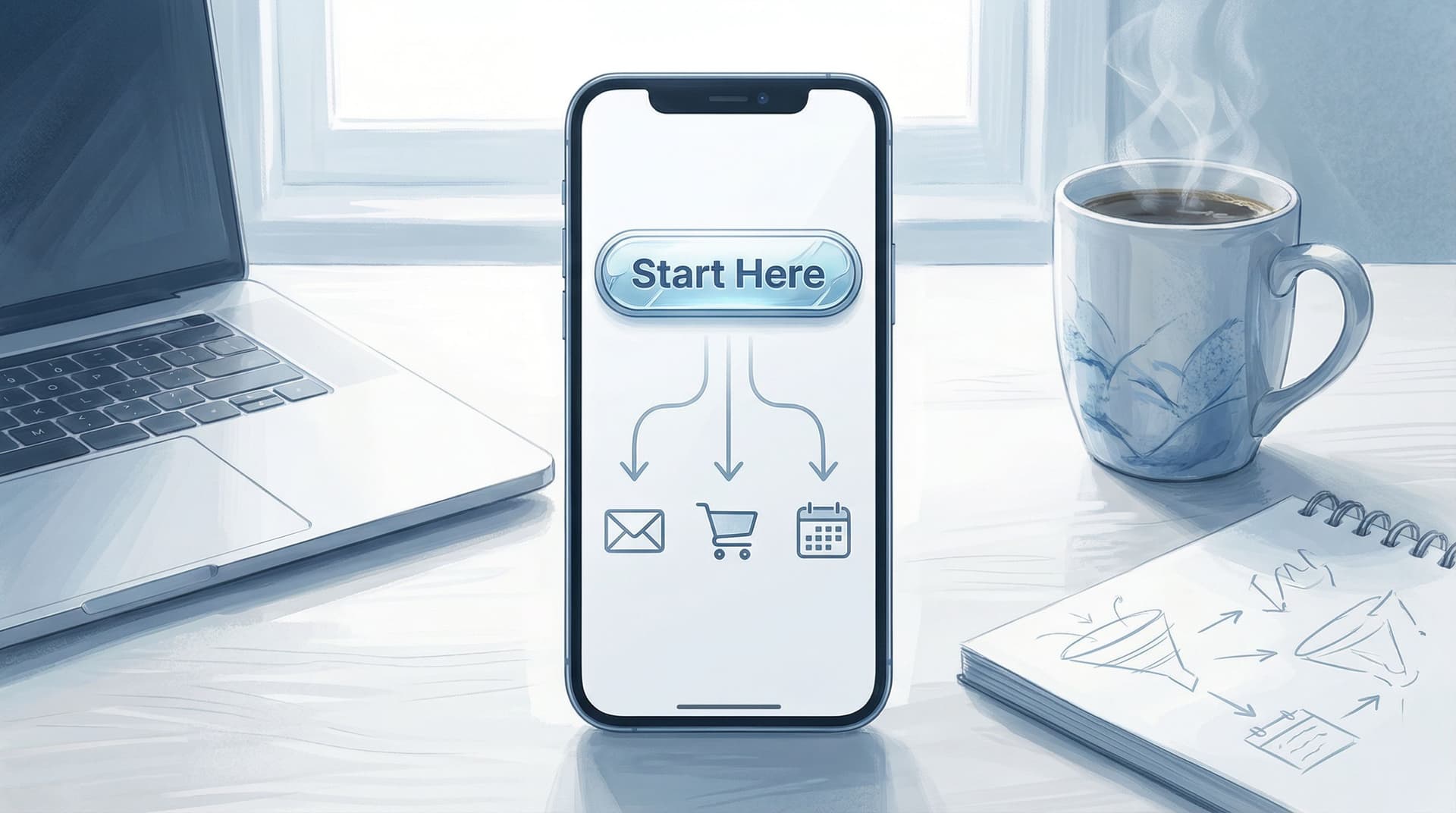
1. Add a Simple “Start Here” Section
At the very top of your page, add:
- A short, clear headline
- “New here? Start with this free guide.”
- “Want clients from Instagram? Watch this first.”
- One sentence of context
- “This 10-minute video shows you how I book clients with 2 posts a week.”
- One main button
- “Get the guide”
- “Watch the free class”
This becomes the entry point to your funnel.
2. Group Links by “Stage,” Not by Topic
Instead of random buckets like “YouTube / Podcast / Shop,” think in stages:
- Discover – free value for people who just met you
- Decide – proof, case studies, FAQs
- Commit – your paid offers, booking links, shop
On Liinks, you can:
- Stack sections vertically in this order
- Use headers like “New? Start Here,” “Ready for More?,” “Work With Me”
- Style each section so it’s visually distinct but still on brand
It quietly nudges people from curious → convinced → committed.
3. Use Micro-Copy to Do the Heavy Lifting
You don’t need long sales pages if your button copy is specific.
Instead of:
- “Newsletter” → try “Get my weekly content prompts (free)”
- “Book” → try “Apply for 1:1 strategy call (limited spots)”
- “Shop” → try “Grab my plug-and-play Canva templates”
This kind of micro-copy is exactly what we unpack in Story-First Liinks: How to Use Micro-Copy, Emojis, and Layout to Guide Clicks Without Being Pushy.
4. Create Alternate Routes for Different People
Hate the idea of one rigid funnel? Good. Don’t build one.
Instead, give different types of visitors their own shortcuts:
- New followers → “Start here” freebie or intro video
- Warm audience → “My main offer” section
- Brands → “For brands & collabs” section leading to your media kit
You can:
- Add a “For Brands” button that links to a Liinks-based media kit (see: Screenshots, Not Spreadsheets: How to Build a Liinks Media Kit Brands Can Skim in 30 Seconds)
- Use different CTAs in your content that all point to the same Liinks URL but reference different sections (“Tap my link and hit the ‘Work With Me’ button.”)
This way, your funnel feels personal, not pushy.
Step 4: Build One Simple Funnel Based on Your Goal
Let’s turn this into concrete examples.
Funnel A: “I Want Email Subscribers”
Goal: Grow your list so you can sell later without begging the algorithm for crumbs.
Your simple path:
- Content mentions a specific freebie
- “Grab my free Notion content calendar—link in bio.”
- Your Liinks page features:
- Top section: “Get the free Notion calendar I use to plan all my posts.”
- Primary button: “Send me the Notion template” → email signup form/landing page
- Below that:
- A “Next Steps” section with:
- “Watch how I use it” (YouTube/TikTok link)
- “Work with me 1:1” (for people who are already obsessed)
- A “Next Steps” section with:
What makes this a funnel, not a random list:
- The freebie is the obvious first step
- The follow-up links are logical next steps once they’re on your list
Funnel B: “I Want More Clients”
Goal: Turn profile lurkers into booked calls.
Your simple path:
- Content talks about client results and invites people to “See how I work—link in bio.”
- Your Liinks page:
- Top section: “Want clients without posting daily? Here’s how I can help.”
- Button 1: “See client results” → case studies or highlight reel
- Button 2: “Apply for a strategy call” → application form
- Below that:
- “Not ready yet?” section with:
- Free training
- Newsletter
- “Not ready yet?” section with:
Why this works:
- You’re not pushing everyone to a call
- You’re giving ready people a fast lane and curious people a warm-up lane
Funnel C: “I Want More Product Sales”
Goal: Sell a digital product, template, or mini-course.
Your simple path:
- Content demos the product and says, “Get the template—link in bio.”
- Your Liinks page:
- Hero section: product name, 1–2 benefit bullets, price
- Button: “Get the template” → checkout page
- Secondary button: “See what’s inside” → short demo or walkthrough
- Below that:
- “Bundle & save” or “More from this series” links
Small tweak that helps: Add a tiny line of social proof under the main button:
- “Used by 500+ creators”
- “Updated for 2026—lifetime access”
Step 5: Check You’re Not Accidentally Building a Maze
Funnels are fine. Mazes are not.
Here’s how to do a quick “maze check” on your Liinks page:
1. The 3-Click Rule
From your main Liinks URL, it should take no more than 3 taps to:
- Join your list
- Book a call
- Buy your main product
If it takes more, something is too buried.
2. The “Stranger Test”
Ask a friend who vaguely knows what you do (but isn’t a superfan) to:
- Tap your bio link
- Narrate what they think they should click next
If they say things like “I’m not sure” or “There’s a lot here,” simplify:
- Fewer buttons above the fold
- Clearer section headers
- One obvious primary action
3. The “Would I Do This on the Bus?” Check
Picture someone on a crowded bus with terrible Wi-Fi and 30 seconds before their stop.
Would they:
- Understand what you offer?
- Know what to click first?
- Be able to complete the action (signup, buy, book) fast?
If the answer is no, your funnel is asking for too much attention.
Step 6: Let Your Stats Talk (Without a Data Meltdown)
You don’t need 900 metrics. You need a few simple signals.
On your Liinks page, pay attention to:
- Top-clicked button
- Is it the thing you actually want people to do?
- Click-through rate on your main CTA
- Are people tapping it at all?
- Dead links
- Buttons that almost no one taps—those might need better copy, better placement, or to be removed
If your main button isn’t getting love:
- Move it higher
- Make the text more specific
- Reduce competing options nearby
If you want a deeper, but still non-headache-y breakdown of what to track, bookmark Analytics Without the Headache: The Only Liinks Metrics Creators Actually Need to Track.
Step 7: Keep It Light, Not Perfect
The whole point of a “funnel for people who hate funnels” is that it doesn’t take over your life.
Give yourself these rules:
- One main goal per 60–90 days
- One primary CTA at the top of your Liinks page
- One tiny experiment per month, like:
- Swapping button copy
- Moving a section higher
- Testing a new freebie as your entry point
You’re not carving this into stone. You’re iterating on a living page that evolves with your content and offers.
If you want a setup that keeps working even when you forget to update it, you’ll like Evergreen, Not Exhausting: How to Build a Liinks Page You Barely Touch but Always Converts.
Quick Recap: Your No-Jargon Funnel in Plain English
Here’s the TL;DR of everything we just walked through:
- A funnel is just a path, not a personality trait.
- Your bio link is the bridge between your content and your offers.
- Use Liinks to:
- Pick one main goal for the next 60–90 days
- Design the laziest possible path to that goal
- Turn your page into a mini funnel with clear stages (Discover → Decide → Commit)
- Give different visitors simple routes that match what they need
- Watch a few key metrics and tweak lightly
You don’t need to “build a funnel.” You just need to stop making people work so hard to do the thing they already want to do.
Your Next Tiny Step (That Builds the Whole Funnel)
You don’t have to overhaul everything.
Here’s a realistic first move you can do in the next 20 minutes:
- Decide your main goal for the next 60–90 days.
- Log into Liinks (or create your account if you haven’t yet).
- Add a single, clear “Start Here” section at the top of your page with:
- One headline
- One sentence of context
- One primary button that leads to your chosen goal
- Move everything else below that section.
That’s it. That’s the beginning of your creator funnel.
Once that’s live, you can start saying in your content:
“Tap the link in my bio and hit the top button to get started.”
No diagrams. No tech spiral. Just a clean, on-brand Liinks page that quietly does the funneling for you.
Ready to make your bio link actually pull its weight? Go set up that “Start Here” button. Your future self—and your future revenue—will be very into it.