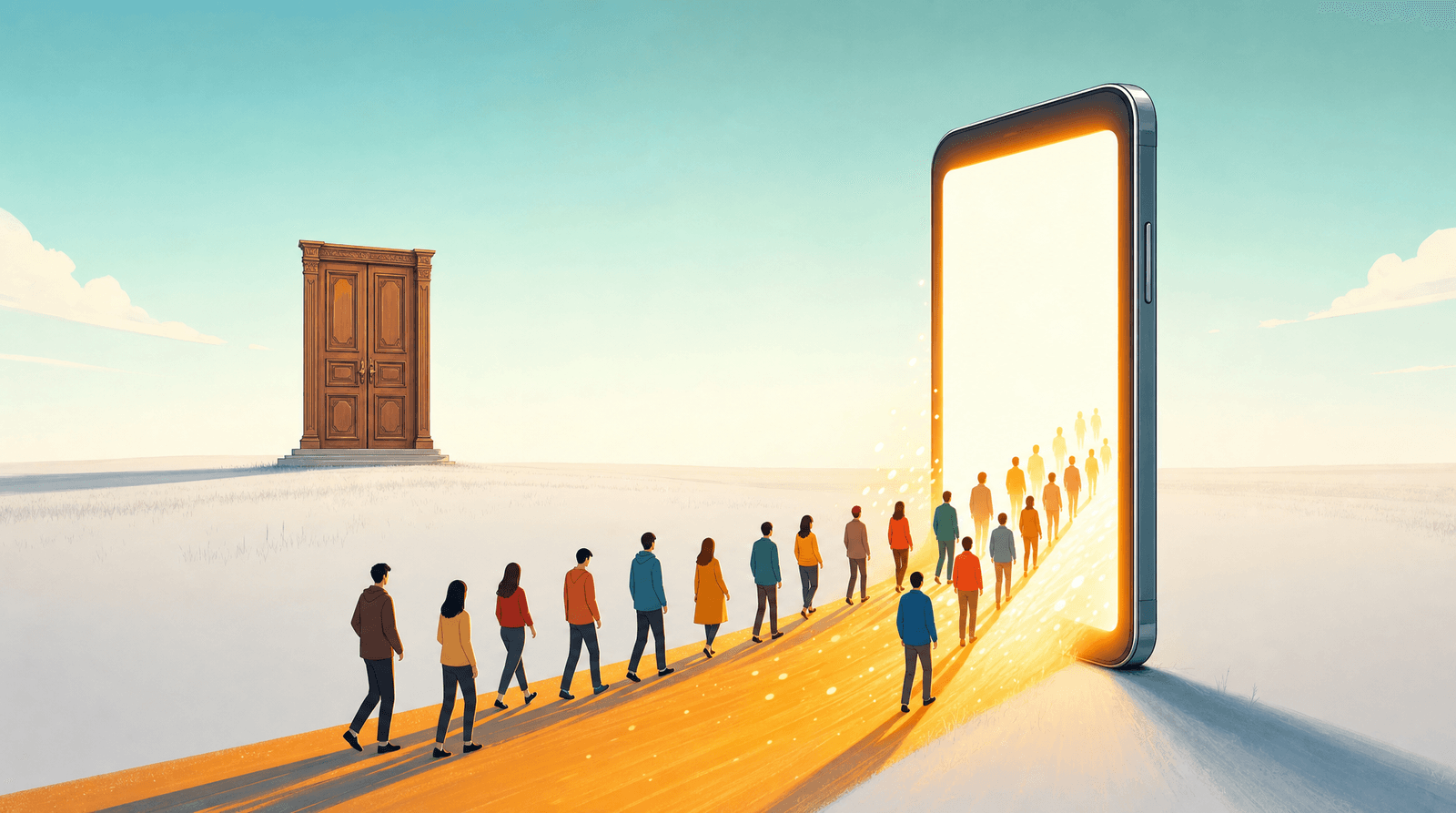
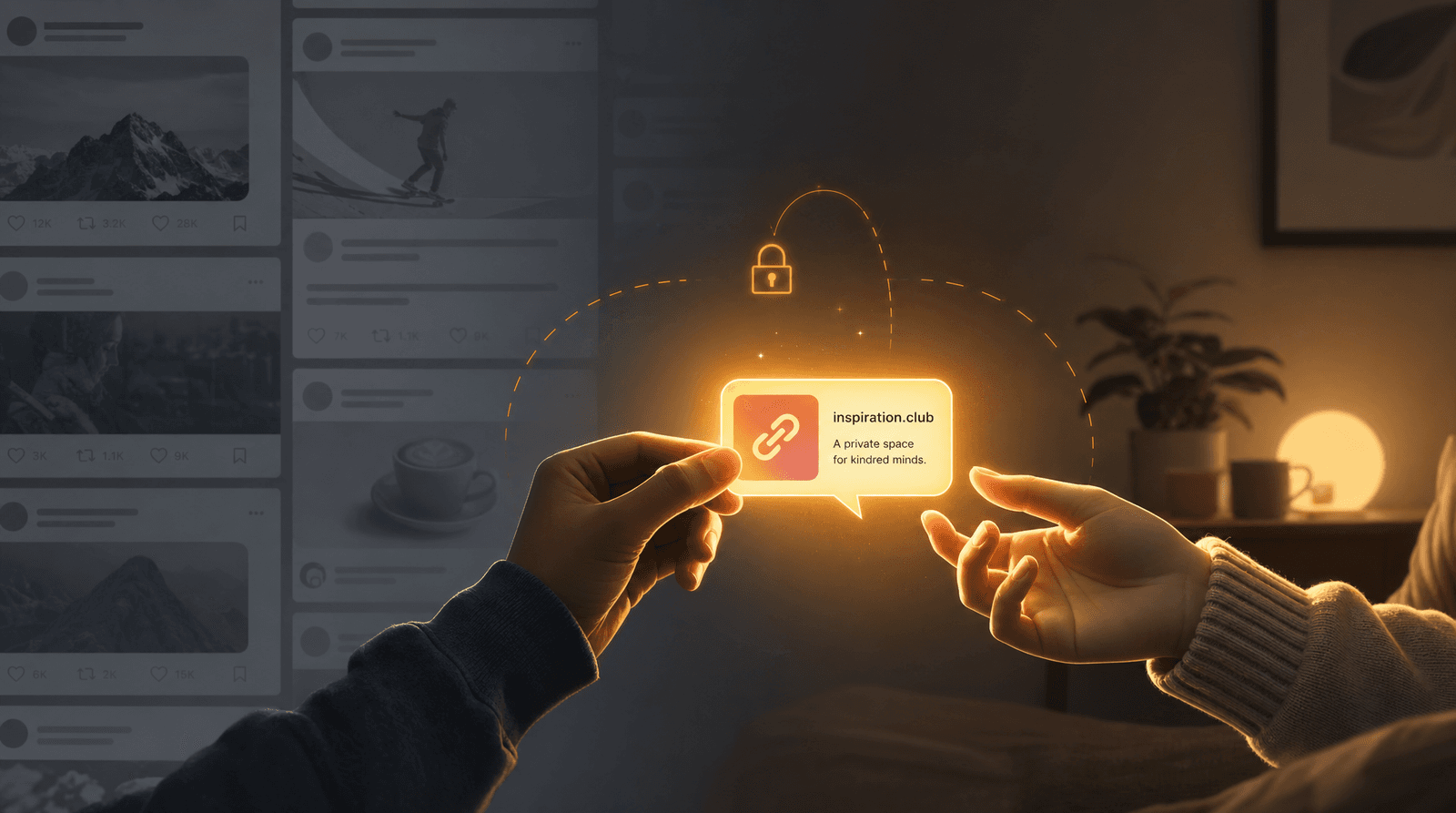
Think about the last time you actually discovered someone new. Not scrolled past. Discovered. The kind where you clicked, poked around, and thought "okay, I'm following this person."
There's a good chance it didn't happen on a feed at all.
It happened because a friend dropped a link in a group chat with three words: "you'll love this." It happened in a DM. It happened when someone screenshotted a page and sent it to exactly one person who they knew would care. No algorithm involved. No public post. No like count. Just one human handing another human a link and a tiny bit of trust.
That is where discovery lives now. And almost nobody is designing for it.
The feed stopped being where things spread
For fifteen years, the whole game was the feed. You made something, the algorithm decided how many people saw it, and reach was a public, measurable thing. You could watch it happen in real time.
That model is quietly breaking. Not because feeds are dying, but because the most valuable sharing moved somewhere you can't watch. Marketers have a name for it: dark social. It's every share that happens through a private channel, a copied-and-pasted link in a text thread, a DM, a Slack, a group chat, an email between two friends. It leaves no public trace. Your analytics just show it as "direct traffic" with no referrer, as if the person typed your URL from memory. They didn't. Someone sent it to them.
Here's the uncomfortable part: dark social isn't a rounding error. Study after study puts the majority of all social sharing in these private channels. The public share button, the retweet, the repost, that's the visible tip. The real iceberg is people talking about you where you can't see it.
And the reason is not mysterious. People trust their group chat more than they trust a feed. A recommendation from a friend carries weight that no amount of reach can buy. When your name comes up in a five-person text thread, you've been vetted by the only algorithm that has ever really mattered: word of mouth.
The platforms noticed this shift too, and not in your favor. They've spent the last few years burying external links so aggressively that a post with a link in it gets throttled the moment you publish it. The feed doesn't want to send people off-platform. So the traffic that used to flow through public posts is rerouting through private ones. When the front door gets locked, people start using the side entrance.
What actually gets shared is your link, not your post
This is the piece most creators miss, and it changes everything about what you build.
When someone recommends you in a group chat, they are not forwarding your best-performing reel. They're not pasting a caption. They're sending a link. One tap. One destination. Because a link is the only thing that survives the trip from one person's screen to another's without falling apart.
So ask yourself what that link points to.
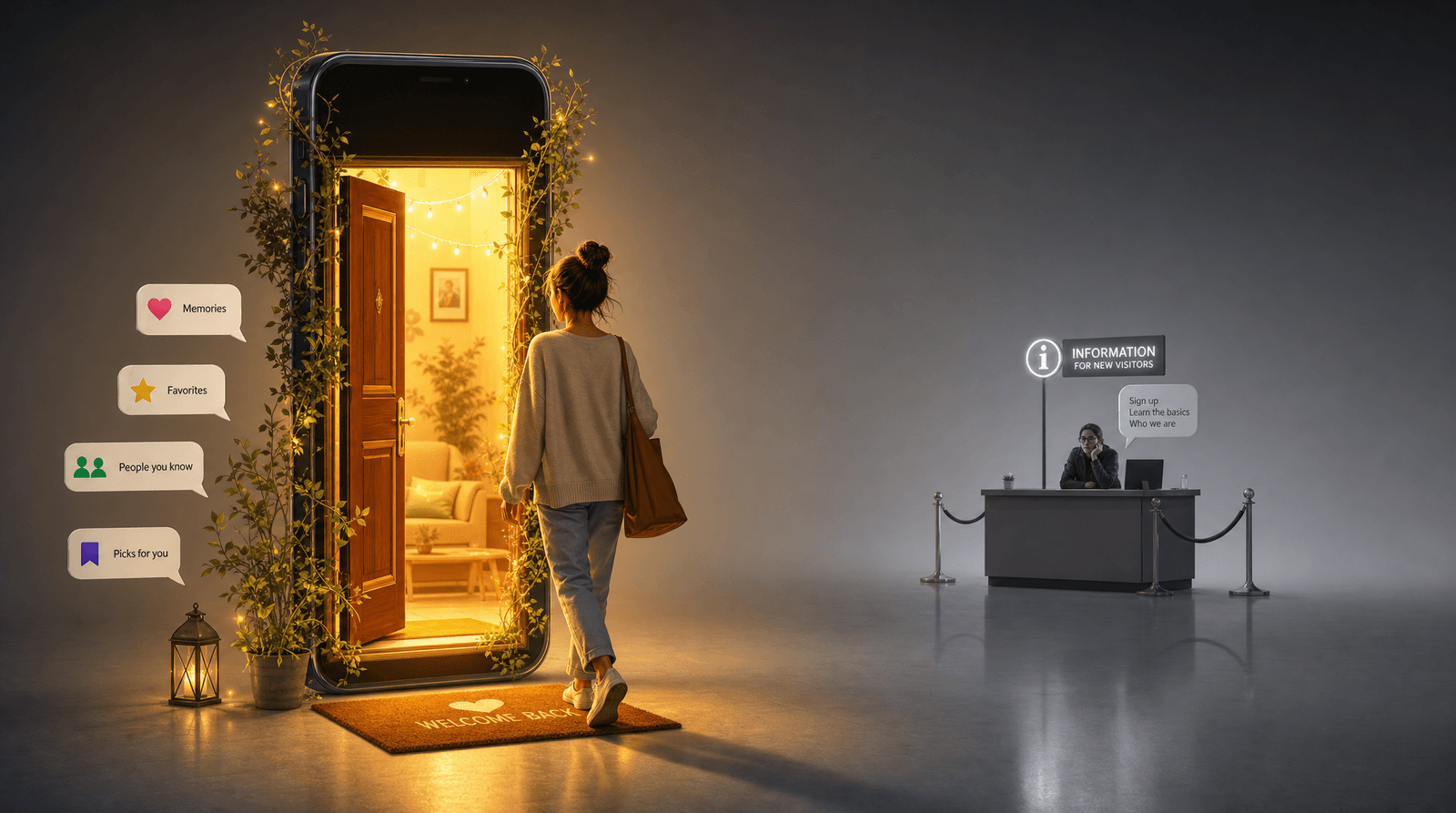
If it points to a raw Instagram profile, your new visitor lands on a grid of images with no context, has to guess what you do, and has to figure out on their own whether the thing their friend was excited about is even here. If it points to a link in bio that's a wall of twenty buttons, they land in a menu with no host, no hierarchy, and no idea where to go first.
Either way, you've wasted the single most valuable moment you'll ever get: a warm introduction from someone the visitor already trusts. Your friend did the hard part. They earned the click. And then the page fumbles the handoff.
The link in bio was invented for a world where discovery was public and your audience arrived warm, already scrolling your feed, already sold. Dark social flips that. A huge share of your most important visitors now arrive cold, sent by a friend, seeing you for the first time, deciding in about four seconds whether the recommendation was worth it.
Your page isn't a menu for existing fans anymore. It's a first impression for strangers who were promised something good.
Design for the person who was just told "check this out"
Once you accept that a big chunk of your traffic is cold, forwarded, and skeptical, the design brief writes itself. You're not building a directory. You're building an introduction that has to land in the four seconds before someone taps back to their group chat.
Lead with who you are and what they'll get, not with links. The top of your page should answer the question the group chat created: "why am I here?" A clear name, a one-line description a stranger actually understands, and one obvious next step. If your page opens with a stack of platform icons and nothing else, you've handed a menu to someone who doesn't know your cuisine yet. This is exactly the trust problem hiding in every link in bio: the visitor is deciding whether to believe the promise their friend made on your behalf, and every vague or cluttered element chips away at it.
Make the first action ridiculously easy. A cold visitor won't do homework. They'll do one thing, maybe. So decide what that one thing is: subscribe, watch, buy, book, read. Put it first, make it big, and don't drown it in ten equally weighted buttons. Fewer, stronger choices win when the visitor has no context. On Liinks, you can control button hierarchy, group related links into sections, and pin the thing you most want a first-timer to do, so the page reads like a host pointing at the good stuff rather than a switchboard.
Give them a reason to stay past the first click. The goal of a warm-referral visit isn't the click. It's the second click, the follow, the subscribe, the "okay, I'm in." A page that looks intentional, on-brand, and alive tells a stranger that the friend who sent them has good taste. A page that looks like an afterthought tells them the opposite, and now your friend looks bad too. That's the quiet stakes of dark social: when someone shares you, they're spending their own credibility. Reward it.
Make yourself shareable on purpose. People forward things that are easy to forward and easy to explain in one sentence. A single clean link that clearly represents your whole world is far more shareable than "go to my Instagram, then click the link in my bio, then scroll down." Every extra step is a place the recommendation dies. Your Liinks URL is one thing to paste and one thing to remember, which is exactly what a group chat needs.
You can't see it, but you can read the signal
The frustrating thing about dark social is that it's invisible by definition. You won't get a notification that says "Priya sent your link to her book club." But you're not flying totally blind.
That wave of "direct" traffic in your analytics, the visits with no referrer that you always assumed were people typing your URL from memory? Most of that is dark social. Nobody is memorizing your link in bio. When you see direct traffic climb after you show up somewhere, or after a piece of work resonates, that's private sharing making itself faintly visible. Watch which pages and links get traffic you can't attribute to any post, and you'll start to see the shape of the conversations happening about you off-platform. Liinks analytics let you see which links get tapped and where visits cluster, so you can at least tell what's landing with the people your fans are recruiting for you.
And here's the strategic reframe: if the majority of real recommendation happens in private, then your job isn't only to reach more people. It's to be more recommendable. To give your existing audience something so clear, so useful, and so easy to pass along that forwarding you becomes a small act of generosity between friends. That's a fundamentally different goal than chasing reach, and it's the same shift we've written about before, that everyone's building an audience while nobody's building a relationship. Relationships are what get shared in group chats. Reach is what gets scrolled past.
TL;DR
- Discovery went private. The majority of social sharing now happens in group chats, DMs, and texts, not in public feeds. It leaves no trace beyond a spike in "direct" traffic.
- What travels is your link, not your post. When a friend recommends you, they paste one link. That link, and the page behind it, has to do the entire job of introducing you.
- A lot of your best visitors arrive cold. They were sent by someone they trust, they've never seen you before, and they decide in seconds whether the recommendation was worth it.
- Design for the cold, forwarded visitor. Lead with who you are, make the first action obvious, look intentional enough to be worth someone's credibility, and be dead-simple to share.
- Read the signal you have. Unattributed direct traffic is dark social becoming faintly visible. Optimize to be recommendable, not just to be seen.
Show up well in rooms you'll never enter
You will never sit in most of the group chats where your name comes up. You can't reach into a text thread and add context, answer a question, or make the case for yourself. All you can do is decide, in advance, what people find when a friend sends them your way.
That's the whole job of a link in bio in the dark social era: to be a great host in a room you're not in. To take a warm introduction and not waste it. To make the person who shared you look like they have great taste.
Liinks gives you a page that's built to do exactly that, clean, fast, on-brand, easy to share, and easy to act on, so the next time someone drops your link in a chat with "you have to check this out," the page more than backs them up. Build yours in a few minutes and give your quietest, most valuable audience something worth passing along.