Stop Designing Your Link-in-Bio for Strangers

Picture the last time you tapped someone's link in bio. Were you a stranger discovering them for the first time? Probably not. You'd seen their stuff before. You followed them weeks ago. Something they posted finally nudged you to go check what they were pointing at. You clicked because you already cared a little.
Now flip it around. When you set up your own page, who did you picture on the other side of the screen? Be honest. You pictured a stranger. A blank slate who needs everything explained, who has to be sold from scratch, who might bounce at any second unless you make the perfect first impression.
That mismatch is the quiet problem at the center of almost every link-in-bio page. The advice industry has trained you to build for the cold visitor, the person who has never heard of you. But the person actually standing at your door, most of the time, is a regular. And you've built a page that treats them like they wandered in off the street.
The audience you're actually serving
Let's be clear about who clicks a link in bio.
To get to your page, someone has to have already found you on a platform, looked at your profile, and decided you were worth a tap. That is not a cold audience. That is a warm one, by definition. The truly cold discovery, where a total stranger stumbles onto your link with zero prior context, is the rare case, not the default.
A meaningful chunk of your clicks come from people who have been to your page before. They followed you a month ago. They watched three of your videos. They're on the fence about buying, or they bought once and might again. They came back not to be convinced you exist, but to see what's new, to find the thing you mentioned, to take the next step with someone they already trust.
When you design exclusively for the stranger, you optimize for the smallest, hardest-to-win slice of your traffic and you ignore the warm majority. You spend all your effort on the people least likely to act and none on the people most likely to.
This is the opposite of how good businesses behave. A great local coffee shop does not treat the regular who comes in every morning like a first-time tourist. They know the order. They have the new seasonal drink ready to mention. They make the loyal customer feel seen, because the loyal customer is the entire business. Your link in bio should run on the same instinct.
What "designing for strangers" actually looks like
You might not think you're doing this. So here are the tells. If your page does most of these, it was built for someone who has never met you.
It explains who you are at length. A big bio block introducing yourself, your credentials, your whole story, parked at the top where the action should be. A stranger might need that. A returning fan has to scroll past their own knowledge to get to what they came for.
Every link is permanent. The same fixed list of buttons that has not changed in months. There's no sense that anything is happening, no "this is new," no reason for a repeat visitor to feel rewarded for coming back. A page that never changes is a page built for people who only ever see it once.
The newest thing is buried. Your latest drop, episode, or launch is somewhere in the middle of the stack, in the same visual weight as a link to a blog post from last year. The person who came specifically because you just announced something has to hunt for it.
Everything has equal priority. Eight buttons, all the same size, all shouting at once. This is the page of someone trying to cover every possible first-time need. It gives the warm visitor no signal about what actually matters right now. We've written before about why nobody remembers a link in bio that asks for everything at once, and the stranger-first mindset is exactly how pages end up that way.
There's no acknowledgment of the relationship. No "thanks for being here," no members-only anything, no nod to the fact that this person chose to come back. The page is transactional when the relationship is anything but.
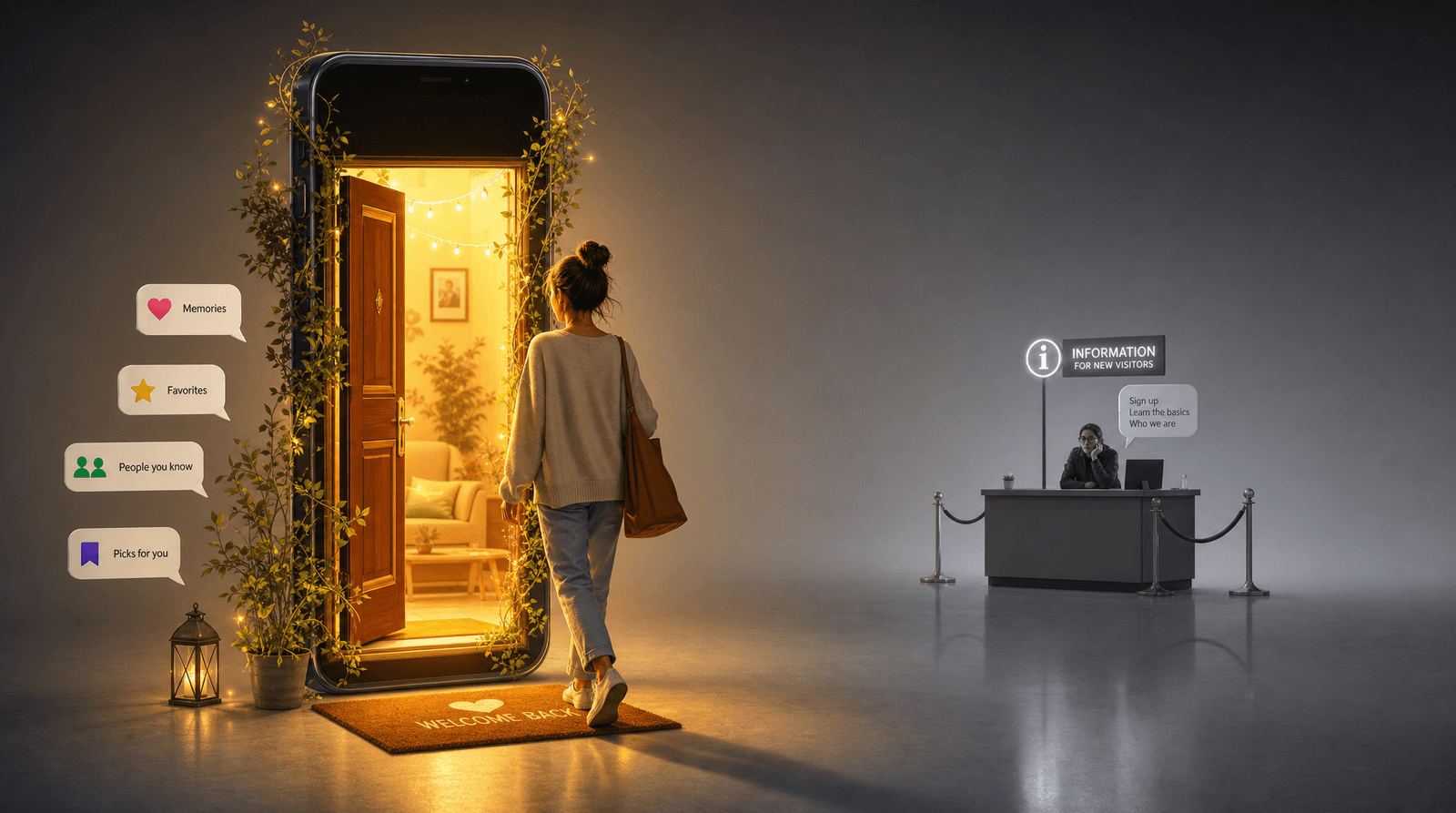
None of these are catastrophic on their own. Together, they add up to a page that feels like a brochure handed to a passerby, when what you needed was a front door held open for a friend.
What changes when you design for the returning fan
Flip the assumption. Assume the person on your page already likes you. What would you build differently?
You'd lead with what's new, not who you are. The top of the page becomes a living space, not a static introduction. The thing you most want people to do this week sits first, in the biggest, brightest spot, and it changes as your week changes. Your Liinks page is meant to be edited in seconds, not treated like a monument you carve once and never touch again.
You'd give returning visitors a reason to feel rewarded. A regular who comes back and sees the exact same page they saw last time learns there's no point checking. A regular who comes back to a fresh "just dropped" section learns the opposite: this is a place where things happen, worth revisiting, worth keeping an eye on. That habit, the habit of coming back, is the single most valuable thing you can build, and it's almost free.
You'd build a hierarchy instead of a list. One clear primary action. A couple of secondary ones. Everything else tucked below the fold for the rare person who really is browsing your whole world. The warm visitor knows what you do; they need to know what to do next, and a flat list of identical buttons answers the wrong question.
You'd talk to the relationship, not around it. A line of copy that assumes familiarity instead of pitching from zero. "Here's where I'll be this month." "The thing half of you have been asking about is finally live." This is how you turn a casual follower into something closer, the slow work of moving people from passive audience to active community, which is the entire difference between building an audience and building a relationship.
The shift is subtle but it changes everything downstream. A stranger-first page asks, "How do I explain myself?" A fan-first page asks, "What does the person who already trusts me need next?" The second question is far easier to answer, and the answer converts far better.
The two-audience page that actually works
Here's the part where I save you from overcorrecting. The goal is not to abandon the stranger entirely. New people do find you, and they matter. The goal is to stop letting the stranger dictate the entire design while the warm majority gets nothing tailored to them.
The good news is you don't have to choose. A well-built page serves both, in order of priority.
Top: the warm fan's reason to be here. Lead with the current, the new, the timely. The primary action you want most people to take right now. This is what the returning visitor came for, and it does no harm to the newcomer, who also benefits from knowing what's front and center.
Middle: the evergreen essentials. Your shop, your newsletter, your main offer. The things that are true whether someone arrived today or six months ago. These serve everyone and are the workhorses of the page.
Bottom: the orientation layer for the truly new. The fuller bio, the "start here," the catalog of everything. The stranger who genuinely needs the whole picture can scroll for it. You've simply stopped forcing it on the 80% who don't.
Liinks makes this kind of structure trivial. Sections let you group and reorder without rebuilding anything. You can lead with a fresh "latest" block one week and swap it for a launch the next. The point is that your page should reflect a hierarchy of who clicks and why, and that hierarchy almost always puts the warm fan first.
And when you do want to actively reward that loyalty, that's its own opportunity. A page built for returning fans is the natural home for the small, direct offers that turn quiet supporters into buyers, which is exactly the playbook we lay out in turning lurkers into superfans with micro-offers. You can only run that play if your page is built to greet the people it's aimed at.
A fast test
Want to know who your current page is built for? Try this.
Open your link in bio and pretend you're someone who followed you a month ago, liked one thing you posted today, and tapped through to act on it. Now time how long it takes you to find the thing they'd want.
If the answer is "instantly, it's right at the top," you're designing for your fans. If the answer is "they'd have to read my bio, scan eight identical buttons, and scroll past last year's content first," you're designing for a stranger who isn't even there.
Then do the same test imagining you're a true first-timer. A good page passes both, but it passes the warm test first, because that's who's actually knocking.
TL;DR
- The person clicking your link in bio is almost never a cold stranger. To get there, they already found you, looked at your profile, and chose to tap. Most of your traffic is warm, and a lot of it is returning.
- Most pages are still built for the stranger: long self-introductions, a frozen list of links, the newest thing buried, everything at equal priority, and zero acknowledgment of the relationship.
- Designing for the returning fan means leading with what's new, building a clear hierarchy instead of a flat list, rewarding people for coming back, and writing copy that assumes familiarity.
- You don't have to pick one audience. A good page serves the warm fan at the top, evergreen essentials in the middle, and the full orientation layer below for the rare true newcomer.
- Run the test: time how long it takes a returning fan to find what they came for. If it's slow, you built the page for the wrong person.
Build a page that greets your regulars
Your most loyal followers are the easiest audience you will ever have, and most link-in-bio pages quietly ignore them. Fixing that doesn't take a redesign. It takes a reorder, a fresh top section, and the decision to assume the best about whoever's clicking.
Liinks is built for exactly this kind of page: sections you can reorder in seconds, a layout that lets you lead with what matters this week, and the flexibility to make your warmest fans feel seen every time they come back. Build the page your regulars deserve, not the one you'd hand to a stranger.
Start building your Liinks page and make your front door worth knocking on twice.