SEO for Social-Only Brands: How to Turn Your Liinks Page into a Searchable ‘Home Base’ for Your Name and Niche

You’ve built a whole brand on vibes and vertical video.
People know you from TikTok, Instagram, YouTube Shorts, maybe a rogue LinkedIn post that accidentally went viral. But when someone Googles you?
Crickets. Or worse: a random old profile, an outdated portfolio, or a LinkedIn headline you wrote in 2020 and have emotionally moved on from.
If you’re a social‑only brand, you don’t necessarily want a full website. You do want one simple, on‑brand place that:
- Shows up when people search your name
- Hints at your niche and what you’re known for
- Funnels people to the right next step (follow, book, buy, binge)
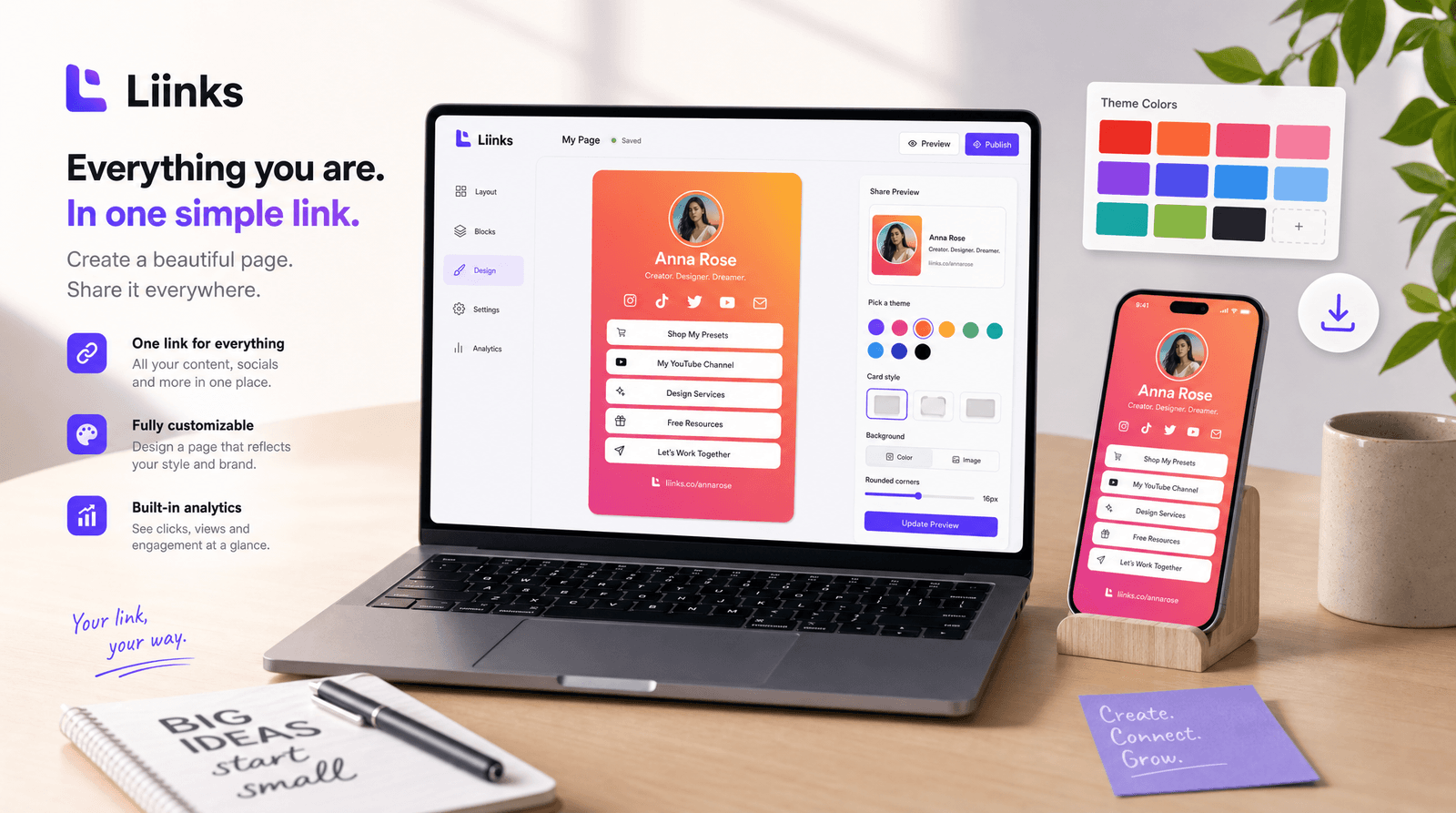
That’s where your Liinks page can quietly become your Google‑friendly “home base.” Not a full site. Not a junk drawer. A tiny, optimized hub that actually ranks for the stuff that matters most to you.
Let’s turn that single bio link into something search engines (and humans) can actually understand.
Why SEO Even Matters If You’re “Just on Social”
You might be thinking: “People find me on TikTok, not Google. Why should I care about SEO?”
Because your audience doesn’t live in one app. They:
- Hear about you from a friend
- See you tagged in someone’s Story
- Catch one of your videos on their FYP
- Then later think, “Wait, what was that creator’s name again?” and type it into Google
A recent Forbes‑backed survey found that 84% of people still turn to search engines for brand name searches—even as younger audiences rely more on social for discovery. That means when someone is trying to confirm who you are, or find you again, Google is still very much in the mix.
If you’re social‑only, you want that search to lead to:
- A page you control
- That looks like you
- That clearly explains what you do
- And that’s easy to keep updated
A.k.a. your Liinks page.
The goal isn’t to outrank giant blogs for “fitness coach” or “brand designer.” The goal is to:
- Own your name search ("yourname", "yourname + niche")
- Show up for a few very specific, long‑tail queries ("yourname Notion templates", "yourname presets", "yourname UGC portfolio")
- Make it obvious what to do next once they land there
Step 1: Decide What You Actually Want to Rank For
Your Liinks page is not going to be your entire SEO empire. Think of it as:
A tiny, powerful homepage for your name and your thing.
Start by answering three questions:
-
If someone Googles you, what should they see first?
- Your main offer?
- Your portfolio?
- Your newsletter?
-
What very specific phrases do you want to be associated with?
Think:your name + nicheoryour name + offer type.“Jordan Lee TikTok UGC creator”“Sam Rivera Notion templates”“Nia Brooks online Pilates classes”
-
What proof do you want on that page that you’re legit?
- A short bio
- Social proof / UGC
- Clear CTAs (book, buy, binge)
Jot down 3–5 phrases that matter most. You’ll weave these into your:
- Page title
- Meta description
- On‑page headings and copy
If you want a deeper dive on choosing search‑friendly angles for your offers, bookmark Creator Revenue Experiments: 7 Low-Lift Offers You Can Test This Month Using Only Your Liinks Page for later.
Step 2: Give Your Liinks Page a Search‑Friendly “Identity”
Search engines need clear signals about what your page is. Fortunately, Liinks gives you enough room to do this without turning your page into a wall of text.
Nail Your Page Title (What Shows in Google Tabs + Results)
Your page title is like your elevator pitch to Google and humans.
Formula to steal:
Your Name | Primary Niche or Role | Key Offer or Hook
Examples:
Jordan Lee | TikTok UGC Creator | Short-Form Video for Beauty & Skincare BrandsNia Brooks | Online Pilates Coach | Low-Impact Strength for Busy MomsSam Rivera | Notion Template Designer | Systems for Creators & Solo Founders
Keep it:
- Under ~60 characters if you can
- Human, not keyword salad
Write a Meta Description That Actually Makes People Click
Meta descriptions don’t directly boost rankings, but they influence click‑through rate (CTR)—and CTR is a strong signal that your page deserves its spot.
Formula to steal:
1–2 sentences that say who you are, who you help, and what they can do on this page.
Example:
Jordan Lee is a TikTok UGC creator helping beauty and skincare brands launch scroll-stopping short-form video. Explore UGC examples, rates, and how to book a project.
Aim for 120–155 characters. Make it sound like something a real person would actually want to click.
If writing this makes your brain melt, you can use ChatGPT as your tiny SEO copy intern—there’s a full walkthrough in AI-Optimized, Human-Approved: Using ChatGPT to Batch-Refresh Your Liinks Page for SEO and Conversions.
Step 3: Add Real Text (Not Just Buttons)
Here’s the big SEO mistake most link‑in‑bio pages make:
They’re just stacks of buttons with almost no descriptive text.
Search engines rely heavily on visible, crawlable text to figure out what a page is about. If your page is just “Shop / Newsletter / YouTube / Book a Call,” there’s nothing to work with.
You don’t need a blog. You do need:
1. A Short, Keyword‑Aware Intro
Think 2–4 sentences at the top of your Liinks page that:
- Use your name
- Mention your niche
- Hint at your main offers or content
Example for a social‑only fitness coach:
I’m Nia Brooks, an online Pilates coach helping busy moms build low-impact strength at home. Start with my 10-minute TikTok-friendly workouts, join the weekly live class, or grab my beginner-friendly program.
That tiny paragraph tells Google (and humans):
- Who you are (Nia Brooks)
- What you do (online Pilates coach)
- Who you help (busy moms)
- What’s on the page (workouts, live class, program)
2. Section Headings That Sound Like Search Queries
Instead of “Stuff I Do” or “Links,” use headings that echo what someone might actually search.
Try:
TikTok UGC Portfolio for Beauty & Skincare BrandsOnline Pilates Programs for Busy MomsNotion Templates for Creators & Solo Founders
Then place your buttons under those headings. You’ve just given your page more semantic context without writing an essay.
3. Micro‑Descriptions Under Important Links
For your top 3–5 links, add a one‑line description. This helps with:
- SEO (more context)
- Conversions (people know what they’re clicking)
Examples:
- Brand Collaboration Page →
See my UGC portfolio, past brand partners, and starting rates. - Signature Program →
8-week low-impact Pilates program for moms who are short on time but big on goals. - Template Shop →
Plug-and-play Notion systems for content planning, launches, and client projects.
Step 4: Make Your Name and Niche Unmissable Across Platforms
SEO isn’t just what happens on your Liinks page. It’s also about consistent signals across the internet that all point to the same “entity” (you).
Match (or Intentionally Align) Your Handles and Name
Where possible:
- Use the same handle (or obvious variations) across platforms
- Use your real name or creator name in your profile names
- Link to your Liinks page from every major profile
When Google sees the same name, similar bios, and the same Liinks URL across TikTok, Instagram, YouTube, etc., it’s much easier for it to:
- Understand that all of this is you
- Treat your Liinks page as a central hub
Use a Consistent One‑Line Bio
Create one strong, keyword‑aware sentence and remix it across platforms.
Example:
TikTok UGC creator helping beauty & skincare brands get scroll-stopping short-form content.
Use that (or a close cousin) on:
- TikTok bio
- Instagram bio
- YouTube description
- LinkedIn headline (if you’re there)
Then point them all to the same Liinks URL.
For more on how this tiny sentence shapes perception before people ever click, see What Your ‘Link in Bio’ Says About You (Before Anyone Ever Clicks): Micro-Branding Tweaks That Change the Story.
Step 5: Turn Your Liinks Page into a “Mini Site” (Without Overbuilding)
You don’t need a 20‑page site. But you can treat your Liinks page like a single, high‑impact homepage.
Think about:
Core Sections to Include
-
Who You Are (Hero Section)
- Name + role + niche
- 1–2 sentence intro
- One primary CTA (book, shop, join, watch)
-
What You Offer
- 3–6 key actions grouped by intent, like:
- Start Here (best intro content, freebie, main playlist)
- Work With Me (services, UGC, coaching, brand deals)
- Shop (templates, presets, products)
- 3–6 key actions grouped by intent, like:
-
Proof You’re Legit
- Logos of brands you’ve worked with
- Short testimonial quotes
- A link to a UGC/review highlight section
-
Deeper Binge Paths
- Link to your best YouTube playlist or TikTok series
- Link to a “Start Here” guide or content hub
Don’t Forget Mobile Experience
Most people will:
- Discover you on mobile
- Tap your bio link on mobile
- Skim your Liinks page on mobile
So:
- Keep sections tight and scannable
- Use clear headings and short paragraphs
- Put your most important CTA within the first scroll
If you want a layout blueprint, pair this SEO setup with the structure from The ‘One Scroll’ Strategy: Designing a Liinks Page That Sells Before Anyone Ever Clicks.
Step 6: Create a Few Easy “Signals” That Point Back to Your Liinks Page
You don’t need a complicated backlink campaign. But a few natural, relevant mentions of your Liinks URL around the internet help reinforce that this is your home base.
Here are low‑stress ways to do it:
1. Update Your Profiles Everywhere
Anywhere there’s a “website” or “link” field, use your Liinks URL:
- TikTok
- YouTube
- X (Twitter)
- Podcast show notes for your own show
These aren’t powerhouse SEO links, but they are consistent entity signals that help search engines understand, “Oh, this URL is where all roads lead.”
2. Add Your Liinks URL to Guest Spots and Collabs
When you:
- Appear on a podcast
- Write a guest post
- Do a collab video or live
Offer your Liinks URL as your main link. It’s easier to say on air (“Everything’s at my Liinks page”) and it centralizes authority to one place.
3. Encourage Fans to Share One Link
If you have:
- A fan community
- Discord
- Group chat
Give them one URL to share when they recommend you: your Liinks page.
This slowly builds a web of mentions that all point back to the same hub.
Step 7: Keep It Fresh (Without Babysitting It)
Search engines like pages that aren’t fossilized.
You don’t need daily updates, but you do want your Liinks page to:
- Reflect your current offers
- Highlight your current best content
- Match what you’re actually talking about on social
A simple rhythm:
-
Once a month:
- Swap in your best recent content
- Update any outdated copy (prices, programs, timelines)
- Add any new social proof or logos
-
Once a quarter:
- Revisit your intro paragraph and headings
- Make sure they still match your niche and goals
If you want to outsource the mental load, pair Liinks with ChatGPT and follow the workflow in AI-Assisted Link in Bio: Using ChatGPT and Liinks Together to Plan Offers, CTAs, and Layouts.
Step 8: How to Tell If It’s Working
You don’t have to become a full‑time SEO analyst. A few quick checks go a long way.
1. Google Yourself Like a Stranger
Open an incognito window and search for:
your nameyour name + nicheyour name + offer(e.g., "your name UGC", "your name presets")
Questions to ask:
- Does your Liinks URL show up on the first page?
- If yes, does the title and snippet look like something you’d click?
- If no, do your social profiles show—and do they clearly lead to your Liinks page?
2. Watch Your Liinks Analytics
Inside Liinks, keep an eye on:
- Overall traffic trend over a few months
- Top links people click after landing
- Any spikes that line up with viral content or collabs
If you see:
- More direct or search‑driven visits
- People consistently clicking your main CTA
…your tiny SEO machine is doing its job.
3. Listen for “I Googled You” Moments
The most underrated metric:
- Clients saying, “I looked you up and found your page.”
- Brands mentioning they “checked out your link” before reaching out.
SEO for social‑only brands is less about volume and more about quality. You don’t need 10,000 random visitors. You need the right 10–100 people a month finding the one page that tells your story clearly.
Quick Recap
To turn your Liinks page into a searchable home base for your name and niche:
- Pick your targets. Decide which name + niche phrases you want to show up for.
- Optimize the basics. Write a clear page title and meta description.
- Add real text. Short intro, descriptive headings, and micro‑copy under key links.
- Stay consistent. Use similar bios and the same Liinks URL across all social profiles.
- Treat it like a mini homepage. Clear sections for who you are, what you offer, and proof.
- Create simple signals. Use your Liinks URL in profiles, collabs, and guest spots.
- Refresh periodically. Update copy and featured content monthly or quarterly.
- Check your progress. Google yourself, skim analytics, and listen to what leads say.
You’re not trying to become an SEO blogger. You’re just making sure that when someone goes looking for you, they actually find you—and land on a page that does you justice.
Your Next Tiny Step
Don’t try to overhaul everything at once. Pick one of these to do this week:
- Rewrite your Liinks page title and meta description using the formulas above.
- Add a 2–4 sentence intro at the top of your page that clearly states who you are, who you help, and how.
- Rename your sections and headings so they sound like the kinds of phrases someone might Google about you.
Once that’s done, set a 20‑minute calendar reminder for next month to tweak and improve.
Your social content is already doing the hard work of getting people curious. Let your Liinks page—and a little bit of SEO—handle the moment when they go from “Who is this?” to “Oh, I get it… and I’m in.”