You Announced It Once. That's Why Nobody Showed Up.


You spent three weeks building the thing. You wrote the caption four times. You picked the photo, you scheduled the post, you hit publish at the time some article told you was optimal.
Then you watched. A few likes. Two comments from people who always comment. One sale, from your friend.
And somewhere in the next 48 hours you quietly decided the offer was wrong. Maybe the price. Maybe the market. Maybe you.
Here is the more likely explanation, and it is much less dramatic: you said it once. One post, in one feed, on one afternoon, to whichever slice of your audience happened to be holding their phone. Then the post scrolled away, and the thing you spent three weeks on went back to being invisible.
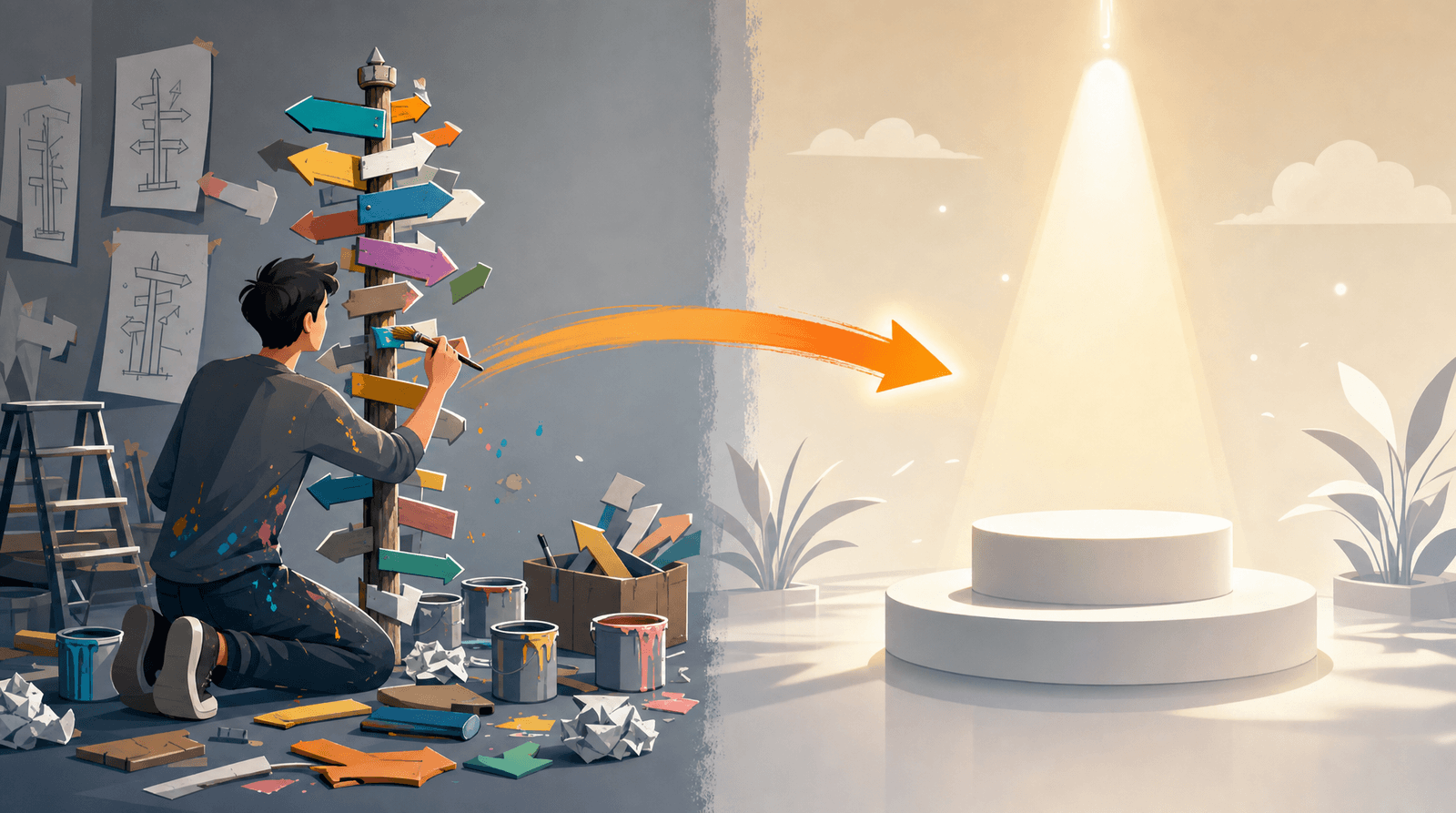
You have seen it a hundred times. They have seen it once, at most
This is the trap, and it catches almost everyone.
By the time you publish an announcement, you have lived inside it for weeks. You have written it, rewritten it, read it back in the preview, sent it to a friend, second guessed the wording, and looked at it one more time before hitting post. In your head, that message has been running on a loop.
Your audience has not been in that loop. At best they saw one post, in the middle of a scroll, between a recipe and someone's dog. Many of them saw nothing at all, because they were asleep, or busy, or the algorithm simply did not put you in front of them that day.
So when you sit down to post about it a second time and feel that hot flush of "everyone already knows, I'm being annoying," check whose experience that feeling is describing. It is describing yours. You are exhausted by the message. They have barely met it.
The feeling is real. The conclusion you draw from it is wrong.
Repetition is not nagging. They are different things.
The fear underneath all of this is a good instinct pointed in the wrong direction. Nobody wants to be the account that turns into a billboard. And that account does exist. We have all muted one.
But go back and look at what those accounts actually do. They do not repeat. They escalate. Same message, same framing, higher volume, more urgency, more exclamation points, more "last chance" that turns out not to be the last chance. Nothing new is offered. The only thing that increases is pressure.
That is nagging. Repetition is different. Repetition says the same thing from a new angle, so that a person who ignored it the first time has a genuine reason to look the second time.
A follower who has not bought your thing is not necessarily a follower who said no. Usually they said "not right now," or "I did not really understand what that was," or nothing at all, because they never registered it as a decision in the first place. Those three people need to hear it again. They do not need to be shouted at.
The real risk of overposting is not that people unfollow. It is quieter than that: they mute you and you never find out. We wrote about that in The Mute Button Is the Real Unfollow, and the distinction matters here, because what gets you muted is monotony and pressure, not frequency on its own. People will happily hear about your launch five times if each time tells them something they did not know.
Five ways to say the same thing
If you only have one way to describe what you launched, you will run out after one post and repetition really will just be volume. So build the angles before you launch, not after the silence.
Here are five that work for almost anything, whether you are selling a preset pack, opening client slots, or announcing that your bakery now does Sunday hours.
1. The plain announcement. What it is, what it costs, when it happens. No story, no build up. Some people just want the facts and they will never dig for them.
2. The why. What made you build it. What kept going wrong before this existed. This one converts the people who like you but did not understand the point.
3. The who it is for. Describe the person this is right for so precisely that they recognize themselves, and, just as usefully, so the wrong person can rule themselves out. Naming who it is not for makes the whole thing more credible, not less.
4. The objection. Say the thing they are quietly thinking. Too expensive, not enough time, tried something similar and it did not stick. Answer it in public. Half your audience is stuck on exactly one sentence and nobody has said it out loud.
5. The proof. One person's result, one message you got, one photo of the thing being used. Not a testimonial wall. One specific human.
That is five posts from one launch, and none of them repeats the previous one. You can add a sixth if there is a real deadline. Just make sure the deadline is real, because a fake one is the fastest way to teach people that your urgency means nothing.
The point is not to fill a calendar. The point is that when you repeat with a new angle, you are not asking your audience to hear you again. You are giving them a new reason to listen.
Every repeat needs somewhere to land
Here is the part most people skip, and it is the part that decides whether any of the repetition works.
Feeds are designed to forget. Stories vanish after 24 hours. Posts sink under whatever you publish next. A message that lives only in your feed has a shelf life measured in hours, which means that every repeat is starting from zero, and the person who finally pays attention on repeat number four has nowhere to go except backwards through your grid.
You need one place that holds the answer permanently, so that every scattered mention in every feed can point at the same door. For most creators and small businesses, that place is the link in bio. It is the one surface you own, the one that does not expire, and the one that every platform funnels people through anyway.
This is why the page matters more during a launch than at any other time. Every new person who hears about the thing goes to check you out, and Every New Follower Visits Your Profile Once is not an exaggeration about how much attention you get on that visit. If your page still leads with whatever you were promoting last month, the repetition in your feed is landing on a locked door.
On Liinks, there are three features worth knowing about here, because they let the page do the repeating for you instead of you doing it manually five times.
The announcement block. One message that shows across your whole profile as a banner at the top, a card in the corner, or a popup on arrival. Every visitor sees it until they dismiss it, so the person who arrives on repeat number four gets the message even if they landed on your page for a completely unrelated reason. It can carry a button or a form, and it can be scheduled to appear and disappear on its own.
Scheduled links. You can set a link to show at a specific date and time and hide itself at another, so a launch link appears on the morning you announce and disappears when the doors close. No 11pm reminder to yourself to take it down. Open a link's action menu and choose Schedule.
A countdown block. If the deadline is real, put it on the page instead of only in your captions. It does the reminding for you, and it does it to everyone who visits, not just to whoever saw today's story.
The pattern is the same in all three cases. Your feed does the reaching. Your page does the remembering.
Know when to stop
Repetition without a stopping rule is how you turn into the account everyone mutes. So decide in advance what tells you to stop, and let it be data rather than vibes.
Vibes will always tell you to stop early, because you are the person most tired of the message. So use the numbers instead.
On your Liinks page, watch the clicks on the specific link you are promoting after each post, not just the total. If the third angle brings in the same tap count as the first, the message is still finding new people and you should keep going. If it falls off a cliff, you have saturated the people who care and it is time to move on.
The announcement block gives you an even more direct signal. Its performance panel tracks views, button clicks, and dismissals, plus the rate at which views turn into clicks. Dismissals are the honest metric here. A dismissal is a person telling you, without any social cost to themselves, that they have registered the message and do not want it. When dismissals climb and clicks flatten, your audience has finished deciding. Take it down.
And then genuinely take it down. A page still promoting a launch that closed three weeks ago is worse than a page with nothing on it, because it tells every new visitor that nobody is home. This is the least glamorous step in any launch, which is exactly why it gets skipped. If you want a fuller version of the drop-day mechanics, The Ultimate Launch Checklist covers the setup side in detail. The teardown deserves the same discipline.
TL;DR
- You have lived with your announcement for weeks. Your audience saw it once, if that. The urge to stop repeating is describing your fatigue, not their experience.
- Nagging is the same message at higher volume. Repetition is the same message from a new angle. Only one of those gets you muted.
- Write five angles before you launch: the plain announcement, the why, the who it is for, the objection, and the proof. That is five posts and zero repeats.
- Every repeat needs one permanent place to land. Feeds forget by design. Your link in bio does not.
- Let the page carry the message: an announcement banner every visitor sees, links scheduled to appear and disappear on their own, a countdown if the deadline is real.
- Stop on data, not on embarrassment. Watch clicks per angle and dismissals on the announcement. Then take it down properly when it is over.
Say it again, somewhere it sticks
The most common launch mistake is not a bad offer or a bad price. It is a good thing announced once, into a surface built to forget, by someone who got shy on the second telling.
Liinks gives you the permanent half of that equation: a page that holds the announcement while your feed does the reaching, with the scheduling and the numbers to tell you when to stop. Every plan comes with a 14-day free trial, so you can have the whole thing set up before your next launch rather than after it.
Build your page at liinks.co, put the thing you are announcing at the top of it, and then go say it a fourth time. Somebody out there is about to hear it for the first time.