Your Audience Isn't Small. It's Just Not Sorted.

Every creator I talk to who thinks they have an audience problem is actually describing a sorting problem.
They say some version of the same thing: "I only have 3,000 followers, so I can't really launch anything yet." Or "engagement is fine but nobody buys." Or the one that gets said most, usually with a shrug: "I don't think my audience wants that."
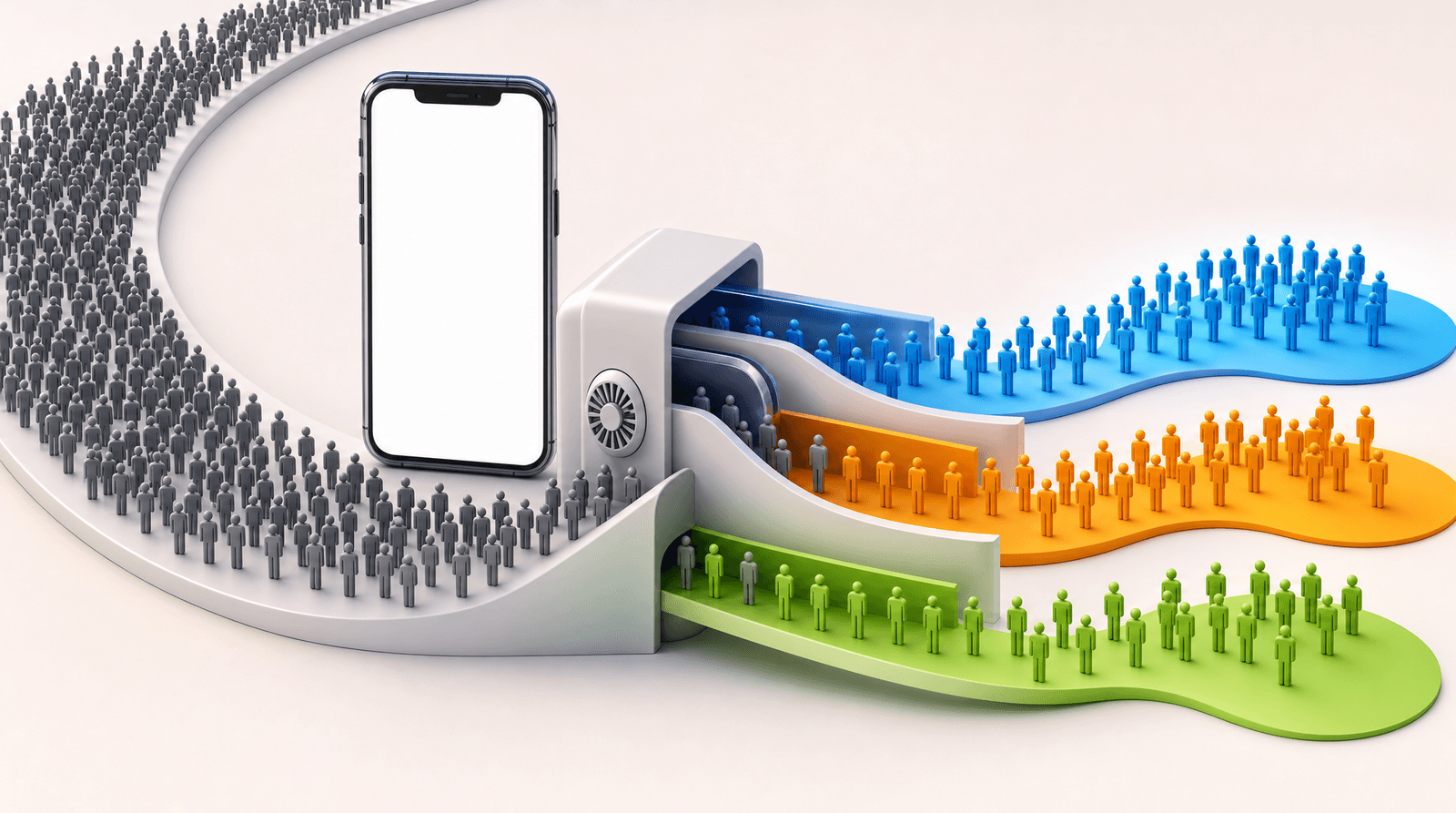
Which audience? Because the person who found you last week through a Reel that got shared into a group chat, the person who has been reading your newsletter for two years, the person who came from a podcast episode where you talked about one very specific thing, and the person who already gave you money once are not the same audience. They are four audiences, standing in one line, being counted as one number.
The number is doing a lot of work it was never designed to do. It flattens four groups with four different levels of trust into one figure, and then you make decisions based on that figure. No wonder the decisions feel wrong.
"Small" is usually a measurement error
Here is the thing about 3,000 followers. If those 3,000 people were one group, all interested in exactly the same thing, all at exactly the same stage, that would genuinely be a small audience. One offer, one message, one conversion rate, and the maths would be tight.
But that is not what you have. What you have is more like: 1,800 people who followed after one post and have never engaged since, 600 who watch most of what you make, 400 who have been around long enough to know your whole story, 150 who have clicked through to something you sell, and maybe 40 who have actually bought. Five groups with wildly different temperatures, and the only thing they share is that they all tapped the same button at some point.
When you post as if all 3,000 are the same, you write for an average person who does not exist. The message is too advanced for the 1,800 and far too basic for the 400. It lands with nobody in particular. Then the engagement is mediocre, and you conclude the audience is too small, when what actually happened is that you aimed at the middle of a group that has no middle.
This is why creators with 2,000 followers routinely out-earn creators with 200,000. It is not luck and it is not some secret funnel. It is that they know which of their people are which, and they stopped talking to the average. We have written before about how to monetize a small audience, and almost every tactic in that piece is downstream of this one idea: know who you are talking to before you decide what to say.
Growth is not the only lever. Sorting is a lever too, and it is the one you can pull this week.
You have four doors, and you built one hallway
Think about how people actually arrive.
The algorithm door. Something of yours got picked up and shown to strangers. These people know one thing about you: the thing in that one post. They have no context, no history, and no particular reason to trust you yet. They are the biggest group and the coldest.
The referral door. Someone they trust sent them. A friend screenshotted your post into a group chat, another creator tagged you, a client recommended you. These people arrive warm, because trust got transferred, but they usually know only the specific thing they were recommended for.
The search door. They went looking for something and found you. A location, a service, a very specific question. These people have intent, which makes them the most valuable and the least patient. They are trying to complete a task.
The relationship door. They already know you. They read the newsletter, they came from a podcast, they bought something, they have been here for years. This is your smallest group and the reason you have a business at all.
Four doors, four different states of mind. And they all land on the same page, in the same order, with the same links, in the same wording.
That is the design flaw. Not the number of people. The fact that the front of your business treats a stranger who has known you for four seconds exactly the same as someone who has bought from you twice.
The stranger needs to know what you are and whether you are for them. The regular needs to know what is new and where to buy. Serving both with one undifferentiated list of links means each one has to scan past everything that is not for them, and scanning is the exact moment people leave. We went deep on that first moment in every new follower visits your profile once, and the short version is that you rarely get a second pass.
Sort them at the door
The good news is that the sorting does not have to happen in your head. It can happen on the page, in the ten seconds after someone taps your link. Your link-in-bio page is the only surface every one of those four groups passes through, which makes it the natural place to split the traffic.
Here is what that looks like in practice.
Lead with the answer to "what is this," not with your inventory
The top of the page is not for links. It is for orientation. One line that says what you do and who it is for, and one obviously primary action underneath it. Everything else can wait.
This costs you nothing with your regulars, because they scroll past orientation without reading it. It changes everything for the cold group, because it is the difference between "I don't know what this is" and "oh, this is for me."
Give each group a visibly different next step
Not more links. Different kinds of links, with different visual weight.
For the cold group: something low-commitment that converts a stranger into a contact you own. An email signup, a free resource, a "start here" post. In Liinks you can put an email capture block right on the page, which means the cheapest possible action is also the one that gives you an audience you can actually reach.
For the warm group: proof and depth. Your best work, testimonials, a portfolio section, the podcast episode where you explain your thinking.
For the intent group: the thing they came to do. Book, buy, enquire, get the address. Make it unmissable and put a price or a timeframe next to it, because ambiguity is what sends people to the DMs, and nobody is going to DM you for prices.
For the relationship group: what is new. A launch, a restock, a fresh episode. This is the one you swap most often.
Four groups, four actions, one page. Sections with headers do most of the work here, because a header lets someone skip an entire block that is not for them instead of reading every button to find out.
Use separate pages when the groups genuinely do not overlap
Sometimes segmentation on one page is not enough. If you run a photography business and a print shop, or you coach beginners and consult for agencies, those are not two sections of one audience. They are two audiences that happen to share a person.
That is when you want more than one page: a dedicated Liinks page per side of the business, and then the link you hand out changes depending on the door. The podcast host gets the coaching page. The Instagram bio gets the main one. Nobody has to scroll past someone else's half of your work.
Change the link you hand out, not just the page
This is the part almost nobody does, and it is free. You control which URL you give to each source. The link in your podcast show notes, the link in your email signature, the link on your business card, and the link in your Instagram bio do not have to be identical. Sending each door to the page that was built for it is the simplest segmentation there is, and it takes an afternoon.
Your analytics already know the answer
You do not have to guess which groups you have. The data is sitting there, and most people never look at it as a sorting question.
Two numbers tell you almost everything.
Which link gets clicked first. Not which gets the most clicks overall, which one people go to first. That is your audience telling you what they actually came for, which is frequently not what you assumed when you built the page. If the "about me" link outperforms the shop, your traffic is colder than you think and you are selling too early. If the shop wins on a page full of content links, you have more intent than you are serving.
Where the traffic comes from. Referrer data is door data. A spike from one platform means the algorithm door is wide open this week and your page is currently full of cold visitors. Steady traffic from a podcast or a newsletter means the relationship door is doing the work. The right top link on a viral Tuesday is not the right top link on a quiet Thursday.
Liinks shows you both, and the useful habit is to check them together rather than separately. Visits without clicks is a page problem. Clicks concentrated on one thing is a signal about who is actually arriving. That second reading is the one that tells you how to sort.
If you want a concrete example of door-specific design, look at what happens when you appear on someone else's show: the audience arrives warm, curious, and with a very specific reference point, which is why turning a podcast guest spot into subscribers works best with a page built for exactly that arrival rather than your everyday one.
"Isn't this overkill for 2,000 followers?"
The opposite, actually.
At 200,000 followers you can afford to be sloppy, because the raw volume compensates. If one in a thousand people converts, you still have a business. Averages work when the numbers are big enough for averages to mean something.
At 2,000, every group is small enough that treating them as one blob wipes out the signal entirely. Forty buyers is not a rounding error at your scale. It is your entire revenue, and those forty people need something visibly different from the 1,800 who followed once and drifted.
Segmentation is not an enterprise marketing concept that trickled down. It is the thing that makes a small audience behave like a bigger one, because you stop wasting the attention of people who were already interested.
And it compounds. Every person you route into an email list is a person you no longer have to catch through an algorithm. Every stranger who lands on a page that immediately makes sense is a stranger who might come back. Sorting is not a one-time cleanup. It is the mechanism by which a small audience turns into a durable one.
Start with one hour
If you do nothing else this week:
- Open your page on your phone and read it as a total stranger. Can you tell what this is and who it is for in five seconds? If not, fix the top of the page before you touch anything else.
- Look at your analytics and find which link gets clicked first. Ask yourself which door that person came through.
- Add one low-commitment action near the top for cold traffic. Email capture is usually the right answer.
- Group your links into sections with headers so people can skip what is not for them.
- Change the link you give to your two biggest non-Instagram sources so it points somewhere built for them.
That is it. No new content, no growth tactics, no algorithm.
TL;DR
- "My audience is too small" is usually a sorting problem, not a size problem. One follower count hides at least four groups with completely different levels of trust.
- People arrive through four doors: the algorithm, a referral, a search, or an existing relationship. Each one arrives in a different state of mind, and each needs a different first action.
- Most link-in-bio pages serve all four with one undifferentiated list of links, which forces every visitor to scan past things that are not for them. Scanning is where people leave.
- Sort on the page: orientation at the top, a low-commitment action for cold traffic, proof for warm traffic, an unmissable buy or book action for high intent, and what's new for regulars. Use sections so people can skip.
- Your analytics already tell you which groups you have. First-click order shows what people came for; referrer data shows which door is currently open.
- Segmentation matters more at 2,000 followers than at 200,000, because at small scale there is no volume to absorb the waste.
Sort your audience this afternoon
You almost certainly have more of an audience than your follower count suggests. The people are there. They are just standing in one undifferentiated line because that is how the page in front of them is built.
Liinks gives you the pieces to fix that: sections with headers so each group can find their part of the page, link styles that make one action clearly primary, an email capture block that turns cold traffic into a list you own, multiple pages when two sides of your business genuinely need their own front door, and analytics that show you which door people came through and what they clicked first.
Start your page for free, open your analytics, and find the first thing people tap. Then build the page for the group that is actually arriving.